
Join Our JEE Preparation Group
Prep with like-minded aspirants; Get access to free daily tests and study material.
Sign in
Please select an account to continue using cracku.in
↓ →
Join Our JEE Preparation Group
Prep with like-minded aspirants; Get access to free daily tests and study material.
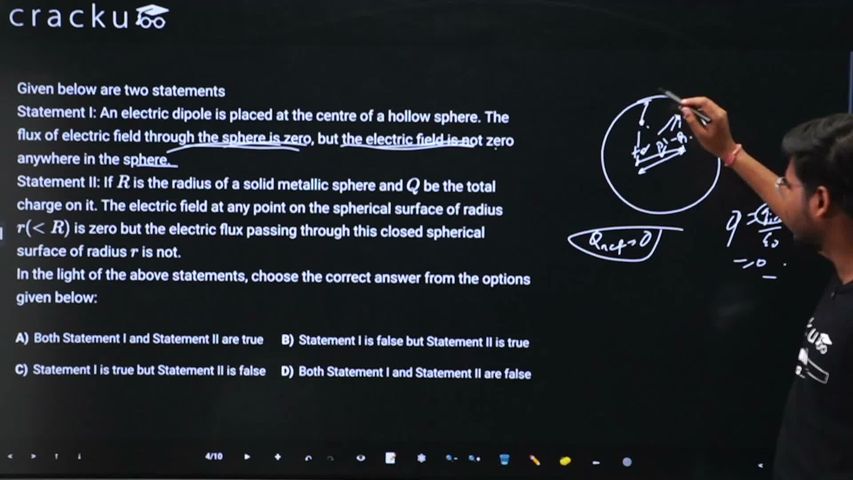
Given below are two statements
Statement I: An electric dipole is placed at the centre of a hollow sphere. The flux of electric field through the sphere is zero, but the electric field is not zero anywhere in the sphere.
Statement II: If $$R$$ is the radius of a solid metallic sphere and $$Q$$ be the total charge on it. The electric field at any point on the spherical surface of radius $$r (< R)$$ is zero but the electric flux passing through this closed spherical surface of radius $$r$$ is not.
In the light of the above statements, choose the correct answer from the options given below:
Statement I: An electric dipole is placed at the centre of a hollow sphere. A dipole consists of two equal and opposite charges, so the total charge enclosed by the sphere is zero. By Gauss's law, the total electric flux through the sphere is $$\Phi = \frac{q_{enc}}{\epsilon_0} = 0$$. However, the electric field due to the dipole is not zero at points inside the sphere (the dipole creates a non-uniform field). Therefore, Statement I is true.
Statement II: For a solid metallic sphere of radius $$R$$ carrying charge $$Q$$, all the charge resides on the outer surface of the conductor. For a Gaussian surface of radius $$r < R$$ (inside the conductor), the electric field is zero everywhere on this surface (as expected inside a conductor in electrostatic equilibrium). By Gauss's law, the flux through this surface is $$\Phi = \frac{q_{enc}}{\epsilon_0} = 0$$, since no charge is enclosed within radius $$r$$. Statement II claims the flux is not zero, which is incorrect. Therefore, Statement II is false.
Hence, Statement I is true but Statement II is false.
Was this solution helpful?
Click on the Email ☝️ to Watch the Video Solution
Create a FREE account and get:
_1.webp)

Educational materials for JEE preparation

Ask our AI anything

AI can make mistakes. Please verify important information.
AI can make mistakes. Please verify important information.


