
Join Our JEE Preparation Group
Prep with like-minded aspirants; Get access to free daily tests and study material.
Sign in
Please select an account to continue using cracku.in
↓ →
Join Our JEE Preparation Group
Prep with like-minded aspirants; Get access to free daily tests and study material.
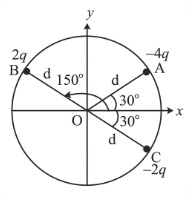
Three charged particles A, B and C with charges $$-4q$$, $$2q$$ and $$-2q$$ are present on the circumference of a circle of radius $$d$$. The charged particles A, C and centre O of the circle formed an equilateral triangle as shown in the figure. The electric field at the point O is
First we recall the basic formula for the electric field produced by a point charge. For a charge $$Q$$ situated at a distance $$r$$ from the observation point, the magnitude of the field is
$$E=\dfrac{1}{4\pi\varepsilon_0}\dfrac{|Q|}{r^{2}}$$
The direction of the field is • from the charge towards the observation point if the charge is positive, and • from the observation point towards the charge if the charge is negative.
In the present problem every charge lies on the circumference of the circle, so the distance of each charge from the centre $$O$$ is the radius $$d$$. Hence for every charge the magnitude of the field at $$O$$ will be
$$\dfrac{1}{4\pi\varepsilon_0}\dfrac{|q_i|}{d^{2}}$$
where $$q_i$$ is the magnitude of the respective charge.
Let us adopt a convenient coordinate system. We place the centre $$O$$ at the origin and take the line $$OA$$ as the positive $$x$$-axis. Because the triangle $$AOC$$ is equilateral, the angle $$\angle AOC$$ equals $$60^{\circ}$$, so the radius $$OC$$ makes an angle $$60^{\circ}$$ with the positive $$x$$-axis.
The figure supplied in the question shows the charge $$B$$ diametrically opposite to the charge $$C$$. Therefore the radius $$OB$$ forms an angle of $$60^{\circ}+180^{\circ}=240^{\circ}$$ with the positive $$x$$-axis.
Now we examine each charge one by one.
Charge at A: Value $$q_A=-4q$$ (negative). Magnitude of its field at $$O$$:
$$E_A=\dfrac{1}{4\pi\varepsilon_0}\dfrac{4q}{d^{2}}$$
Because the charge is negative, the field points from $$O$$ towards $$A$$, i.e. outward along the radius $$OA$$ or the $$+x$$ direction. Hence in vector form
$$\vec E_A=\dfrac{1}{4\pi\varepsilon_0}\dfrac{4q}{d^{2}}\;\hat i$$
Charge at C: Value $$q_C=-2q$$ (negative). Magnitude:
$$E_C=\dfrac{1}{4\pi\varepsilon_0}\dfrac{2q}{d^{2}}$$
Direction is outward along the radius $$OC$$, that is at $$60^{\circ}$$.
$$\vec E_C=\dfrac{1}{4\pi\varepsilon_0}\dfrac{2q}{d^{2}}\;(\cos60^{\circ}\,\hat i+\sin60^{\circ}\,\hat j)$$
Charge at B: Value $$q_B=+2q$$ (positive). Magnitude:
$$E_B=\dfrac{1}{4\pi\varepsilon_0}\dfrac{2q}{d^{2}}$$
This time the charge is positive, so the field points from the charge towards the centre, i.e. inward along the radius $$BO$$. Since the outward radius $$OB$$ is at $$240^{\circ}$$, the inward direction is opposite to it, namely $$240^{\circ}-180^{\circ}=60^{\circ}$$. Thus $$\vec E_B$$ is also directed at $$60^{\circ}$$.
$$\vec E_B=\dfrac{1}{4\pi\varepsilon_0}\dfrac{2q}{d^{2}}\;(\cos60^{\circ}\,\hat i+\sin60^{\circ}\,\hat j)$$
We now add the three vector contributions.
First collect the $$x$$-components:
$$E_x=\dfrac{1}{4\pi\varepsilon_0\,d^{2}}\Big[4q\;(1)+2q\;(\cos60^{\circ})+2q\;(\cos60^{\circ})\Big]$$
Using $$\cos60^{\circ}= \dfrac12$$, we get
$$E_x=\dfrac{1}{4\pi\varepsilon_0\,d^{2}}\Big[4q+2q\left(\dfrac12\right)+2q\left(\dfrac12\right)\Big] =\dfrac{1}{4\pi\varepsilon_0\,d^{2}}\Big[4q+q+q\Big] =\dfrac{1}{4\pi\varepsilon_0\,d^{2}}\;(6q)$$
So
$$E_x=\dfrac{6q}{4\pi\varepsilon_0 d^{2}}$$
Next the $$y$$-components:
$$E_y=\dfrac{1}{4\pi\varepsilon_0\,d^{2}}\Big[4q\;(0)+2q\;(\sin60^{\circ})+2q\;(\sin60^{\circ})\Big]$$
Because $$\sin60^{\circ}= \dfrac{\sqrt3}{2}$$,
$$E_y=\dfrac{1}{4\pi\varepsilon_0\,d^{2}}\Big[2q\left(\dfrac{\sqrt3}{2}\right)+2q\left(\dfrac{\sqrt3}{2}\right)\Big] =\dfrac{1}{4\pi\varepsilon_0\,d^{2}}\;\big[q\sqrt3+q\sqrt3\big] =\dfrac{1}{4\pi\varepsilon_0\,d^{2}}\;(2\sqrt3\,q)$$
Thus
$$E_y=\dfrac{2\sqrt3\,q}{4\pi\varepsilon_0 d^{2}}$$
The resultant electric field vector is
$$\vec E=\big(E_x\,\hat i+E_y\,\hat j\big)$$
Its magnitude is calculated by Pythagoras:
$$|\vec E|=\sqrt{E_x^{2}+E_y^{2}} =\sqrt{\left(\dfrac{6q}{4\pi\varepsilon_0 d^{2}}\right)^{2}+\left(\dfrac{2\sqrt3\,q}{4\pi\varepsilon_0 d^{2}}\right)^{2}}$$
$$|\vec E|=\dfrac{q}{4\pi\varepsilon_0 d^{2}}\;\sqrt{(6)^{2}+(2\sqrt3)^{2}} =\dfrac{q}{4\pi\varepsilon_0 d^{2}}\;\sqrt{36+12} =\dfrac{q}{4\pi\varepsilon_0 d^{2}}\;\sqrt{48}$$
Since $$\sqrt{48}=4\sqrt3$$, we obtain
$$|\vec E|=\dfrac{q}{4\pi\varepsilon_0 d^{2}}\;(4\sqrt3) =\dfrac{\sqrt3\,q}{\pi\varepsilon_0 d^{2}}$$
Therefore the magnitude of the electric field at the centre is
$$E=\dfrac{\sqrt3\,q}{\pi\varepsilon_0 d^{2}}$$
Hence, the correct answer is Option A.
Was this solution helpful?
Click on the Email ☝️ to Watch the Video Solution
Create a FREE account and get:
_1.webp)

Educational materials for JEE preparation

Ask our AI anything

AI can make mistakes. Please verify important information.
AI can make mistakes. Please verify important information.
