
Join Our JEE Preparation Group
Prep with like-minded aspirants; Get access to free daily tests and study material.
Sign in
Please select an account to continue using cracku.in
↓ →
Join Our JEE Preparation Group
Prep with like-minded aspirants; Get access to free daily tests and study material.
In the figure, the inner (shaded) region A represents a sphere of radius $$r_A = 1$$, within which the electrostatic charge density varies with the radial distance $$r$$ from the center as $$\rho_A = kr$$, where $$k$$ is positive. In the spherical shell B of outer radius $$r_B$$, the electrostatic charge density varies as $$\rho_B = \dfrac{2k}{r}$$. Assume that dimensions are taken care of. All physical quantities are in their SI units.
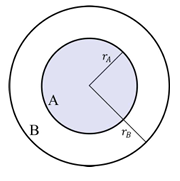
Which of the following statement(s) is(are) correct?
The charge distribution is spherically symmetric, so we can treat every region with Gauss’s law.
1. Charge enclosed by the inner solid sphere A ($$r_A = 1$$)
Density: $$\rho_A = k r$$ for $$0 \le r \le 1$$.
$$\displaystyle Q_A = \int_{0}^{1} \rho_A\,4\pi r^2 \,dr = 4\pi k\int_{0}^{1} r^3\,dr
= 4\pi k\left[\frac{r^4}{4}\right]_{0}^{1}= \pi k$$
2. Charge enclosed in the shell B up to an outer radius $$r_B$$
Density: $$\rho_B = \dfrac{2k}{r}$$ for $$1 \le r \le r_B$$.
$$\displaystyle Q_B = \int_{1}^{r_B} \rho_B\,4\pi r^2\,dr
= 4\pi \int_{1}^{r_B} \frac{2k}{r}\,r^2\,dr
= 8\pi k\int_{1}^{r_B} r\,dr
= 8\pi k\left[\frac{r^2}{2}\right]_{1}^{r_B}
= 4\pi k\bigl(r_B^2-1\bigr)$$
3. Total charge of the whole distribution
$$\displaystyle Q_{\text{tot}} = Q_A + Q_B
= \pi k + 4\pi k\bigl(r_B^2-1\bigr)
= \pi k\,[\,4r_B^2-3\,]$$
4. Electric field outside the shell ( r > rB )
Outside the outer radius the entire charge behaves like a point charge at the centre:
$$\displaystyle E(r) = \frac{1}{4\pi\epsilon_0}\,\frac{Q_{\text{tot}}}{r^2},
\qquad r \ge r_B$$
5. Checking each option
Case A: $$r_B=\sqrt{\dfrac{3}{2}}\,(\approx1.225)$$Hence, the only correct statement is:
Option B which is: If $$r_B = \dfrac{3}{2}$$, then the electric potential just outside B is $$\dfrac{k}{\epsilon_0}$$.
Was this solution helpful?
Create a FREE account and get:
_1.webp)

Educational materials for JEE preparation

Ask our AI anything

AI can make mistakes. Please verify important information.
AI can make mistakes. Please verify important information.
