
Join Our JEE Preparation Group
Prep with like-minded aspirants; Get access to free daily tests and study material.
Sign in
Please select an account to continue using cracku.in
↓ →
Join Our JEE Preparation Group
Prep with like-minded aspirants; Get access to free daily tests and study material.
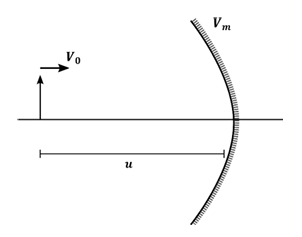
An object and a concave mirror of focal length $$f = 10$$ cm both move along the principal axis of the mirror with constant speeds. The object moves with speed $$V_0 = 15$$ cm s$$^{-1}$$ towards the mirror with respect to a laboratory frame. The distance between the object and the mirror at a given moment is denoted by $$u$$. When $$u = 30$$ cm, the speed of the mirror $$V_m$$ is such that the image is instantaneously at rest with respect to the laboratory frame, and the object forms a real image. The magnitude of $$V_m$$ is _______ cm s$$^{-1}$$.
Correct Answer: 3
Let the pole of the mirror be the origin and the principal axis be the positive $$x$$-axis directed towards the right. Hence distances measured towards the left are negative.
The focal length of a concave mirror is negative, so
$$f = -10\ \text{cm}$$
At the instant of interest the separation between the object and the mirror is
$$u_{\text{mag}} = 30\ \text{cm}$$
With the sign convention this becomes
$$u = -30\ \text{cm}$$
Using the mirror formula
$$\frac{1}{f} = \frac{1}{u} + \frac{1}{v}\quad -(1)$$
Substituting $$f = -10\ \text{cm}$$ and $$u = -30\ \text{cm}$$ in (1):
$$\frac{1}{-10} = \frac{1}{-30} + \frac{1}{v}$$
$$\frac{1}{v} = -\frac{1}{10} + \frac{1}{30} = -\frac{2}{30} = -\frac{1}{15}$$
$$\Rightarrow\ v = -15\ \text{cm}$$
Thus the image is formed $$15\ \text{cm}$$ in front of the mirror (real image, left side).
Let
$$x_m(t)$$ be the mirror position, $$x_o(t)$$ the object position, $$x_i(t)$$ the image position (all in the laboratory frame).
Object speed (towards the mirror):
$$V_o = +15\ \text{cm s}^{-1}$$
Mirror speed (to be found): $$V_m$$ (taken positive towards the right).
Signed object distance from the mirror is
$$u = x_o - x_m\quad\Rightarrow\quad \frac{du}{dt} = V_o - V_m = 15 - V_m$$
Signed image distance from the mirror is $$v$$. Differentiate the mirror formula $$\frac{1}{f} = \frac{1}{u} + \frac{1}{v}$$ with respect to time:
$$0 = -\frac{1}{u^{2}}\frac{du}{dt} - \frac{1}{v^{2}}\frac{dv}{dt}$$
$$\Rightarrow\ \frac{dv}{dt} = -\frac{v^{2}}{u^{2}}\frac{du}{dt}$$
At the given instant $$u = -30\ \text{cm}$$ and $$v = -15\ \text{cm}$$, so
$$\frac{v^{2}}{u^{2}} = \frac{(-15)^{2}}{(-30)^{2}} = \frac{225}{900} = \frac14$$
Hence
$$\frac{dv}{dt} = -\frac14\left(15 - V_m\right)$$
The image position in the laboratory frame is
$$x_i = x_m + v$$ (because $$v$$ is measured from the mirror towards the left).
Therefore
$$\frac{dx_i}{dt} = V_m + \frac{dv}{dt}$$
The question states that the image is instantaneously at rest in the laboratory frame, so
$$\frac{dx_i}{dt} = 0$$
$$\Rightarrow\ V_m + \frac{dv}{dt} = 0$$
Insert $$\frac{dv}{dt}$$ from above:
$$V_m - \frac14\left(15 - V_m\right) = 0$$
Multiply by 4:
$$4V_m - (15 - V_m) = 0$$
$$5V_m - 15 = 0$$
$$\boxed{V_m = 3\ \text{cm s}^{-1}}$$
The mirror must move rightwards with speed $$3\ \text{cm s}^{-1}$$. Its magnitude is therefore 3 cm s$$^{-1}$$, which satisfies the additional requirement that the image remains real.
Was this solution helpful?
Create a FREE account and get:
_1.webp)

Educational materials for JEE preparation

Ask our AI anything

AI can make mistakes. Please verify important information.
AI can make mistakes. Please verify important information.
