
Join Our JEE Preparation Group
Prep with like-minded aspirants; Get access to free daily tests and study material.
Sign in
Please select an account to continue using cracku.in
↓ →
Join Our JEE Preparation Group
Prep with like-minded aspirants; Get access to free daily tests and study material.
As shown in the figure, a point charge $$Q$$ is placed at the centre of conducting spherical shell of inner radius $$a$$ and outer radius $$b$$. The electric field in three different regions I, II and III is given by:
(I: $$r < a$$, II: $$a < r < b$$, III: $$r > b$$)
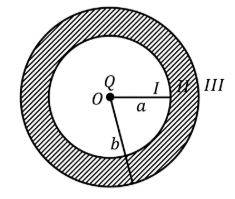
For a point charge Q placed at the centre of a conducting spherical shell:
Regions are:
We examine electric field in each region.
For Region I (r<a)
Using Gauss law, take a spherical Gaussian surface of radius r<ar
Only charge enclosed is Q.
$$\oint\vec{E}\cdot d\vec{A}=\frac{Q}{\varepsilon_0}$$
Since symmetry makes E constant over the surface,
$$E(4\pi r^2)=\frac{Q}{\varepsilon_0}$$
$$E_I=\frac{1}{4\pi\varepsilon_0}\frac{Q}{r^2}\ne0$$
For Region II (a<r<b):
This is the conducting material.
In electrostatic equilibrium, electric field inside a conductor is zero.
$$E_{II}=0$$
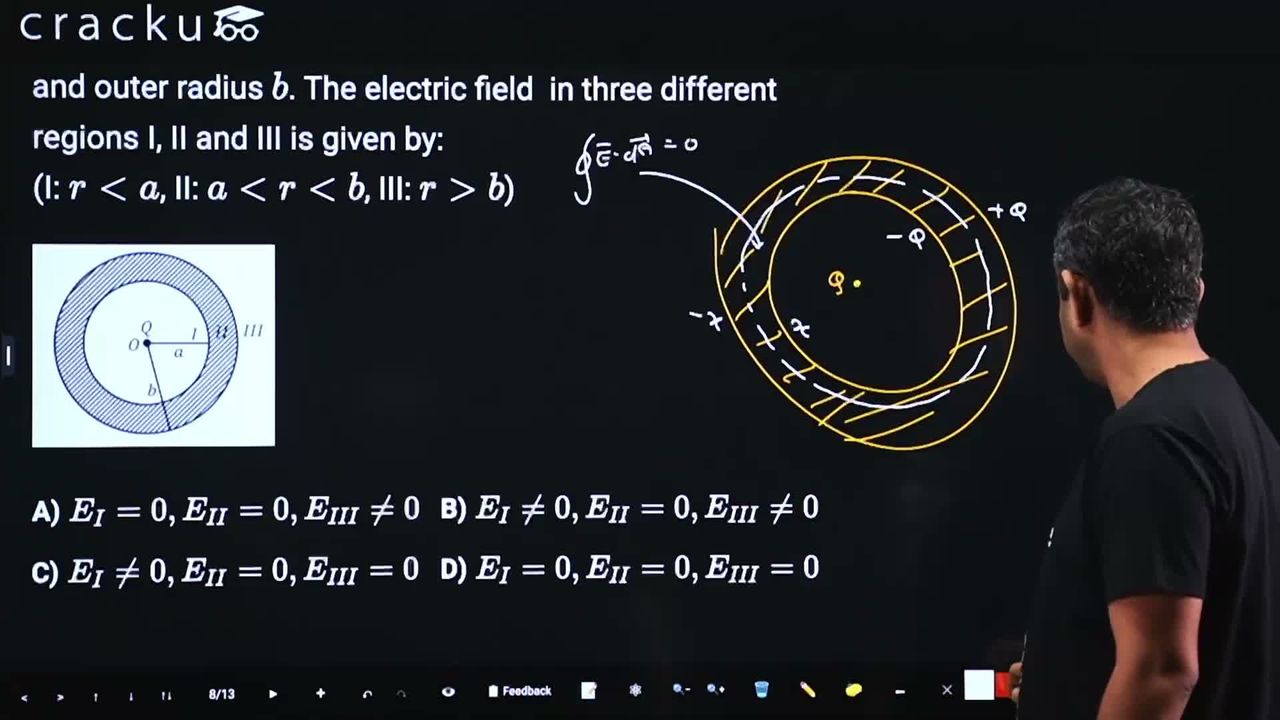
This happens because charge Q induces
so field inside the conductor cancels.
For Region III (r>b):
Take a Gaussian sphere of radius r>b.
Total enclosed charge is
$$Q+(-Q)+(+Q)=Q$$
Using Gauss law,
$$E(4\pi r^2)=\frac{Q}{\varepsilon_0}$$
$$E_{III}=\frac{1}{4\pi\varepsilon_0}\frac{Q}{r^2}\ne0$$
So field outside is not zero; the whole system behaves like a point charge Q at the centre.
Therefore,
$$EI\ne0,E_I\ne0,\quad\quad E_{III}\ne0$$
Correct option:
B
Was this solution helpful?
Click on the Email ☝️ to Watch the Video Solution
Create a FREE account and get:
_1.webp)

Educational materials for JEE preparation

Ask our AI anything

AI can make mistakes. Please verify important information.
AI can make mistakes. Please verify important information.
