
Join Our JEE Preparation Group
Prep with like-minded aspirants; Get access to free daily tests and study material.
Sign in
Please select an account to continue using cracku.in
↓ →
Join Our JEE Preparation Group
Prep with like-minded aspirants; Get access to free daily tests and study material.
As shown in the figure, a current of $$2$$ A flowing in an equilateral triangle of side $$4\sqrt{3}$$ cm. The magnetic field at the centroid $$O$$ of the triangle is:
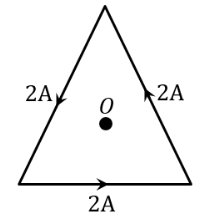
(Neglect the effect of earth's magnetic field)
We need to find the magnetic field at the centroid of an equilateral triangle carrying current $$I = 2$$ A with side $$a = 4\sqrt{3}$$ cm.
The perpendicular distance from the centroid to each side of an equilateral triangle is:
$$d = \frac{a}{2\sqrt{3}} = \frac{4\sqrt{3}}{2\sqrt{3}} = 2 \text{ cm} = 0.02 \text{ m}$$
Now, each side subtends an angle of $$60°$$ on either end as seen from the centroid. The magnetic field due to a finite straight conductor at perpendicular distance $$d$$ is:
$$B_{\text{one side}} = \frac{\mu_0 I}{4\pi d}(\sin\alpha + \sin\beta)$$
For each side, $$\alpha = \beta = 60°$$, so:
$$B_{\text{one side}} = \frac{\mu_0 I}{4\pi d} \times 2\sin 60° = \frac{\mu_0 I}{4\pi d} \times \sqrt{3}$$
By symmetry, all three sides produce magnetic fields in the same direction (perpendicular to the plane, by the right-hand rule). Hence the total field is:
$$B = 3 \times \frac{\mu_0 I}{4\pi d} \times \sqrt{3} = \frac{3\sqrt{3}\mu_0 I}{4\pi d}$$
Substituting values:
$$B = \frac{3\sqrt{3} \times 10^{-7} \times 2}{0.02} = \frac{6\sqrt{3} \times 10^{-7}}{0.02} = 3\sqrt{3} \times 10^{-5} \text{ T}$$
So, the answer is $$3\sqrt{3} \times 10^{-5}$$ T.
Was this solution helpful?
Create a FREE account and get:
_1.webp)

Educational materials for JEE preparation

Ask our AI anything

AI can make mistakes. Please verify important information.
AI can make mistakes. Please verify important information.
