
Join Our JEE Preparation Group
Prep with like-minded aspirants; Get access to free daily tests and study material.
Sign in
Please select an account to continue using cracku.in
↓ →
Join Our JEE Preparation Group
Prep with like-minded aspirants; Get access to free daily tests and study material.
A satellite is launched into a circular orbit of radius $$R$$ around earth, while a second satellite is launched into a circular orbit of radius 1.02 $$R$$. The percentage difference in the time periods of the two satellites is:
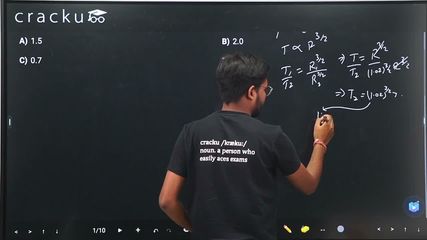
By Kepler's third law, $$T \propto R^{3/2}$$. If the first satellite has orbital radius $$R$$ with period $$T$$, and the second has radius $$1.02R$$, then $$T' = T(1.02)^{3/2}$$.
The percentage difference is $$\frac{T' - T}{T} \times 100 = \left[(1.02)^{3/2} - 1\right] \times 100$$.
Using the binomial approximation $$(1+x)^n \approx 1 + nx$$ for small $$x$$: $$(1.02)^{3/2} \approx 1 + \frac{3}{2}(0.02) = 1 + 0.03 = 1.03$$.
Therefore the percentage difference is approximately $$3.0\%$$.
Was this solution helpful?
Click on the Email ☝️ to Watch the Video Solution
Create a FREE account and get:
_1.webp)

Educational materials for JEE preparation

Ask our AI anything

AI can make mistakes. Please verify important information.
AI can make mistakes. Please verify important information.
