
Join Our JEE Preparation Group
Prep with like-minded aspirants; Get access to free daily tests and study material.
Sign in
Please select an account to continue using cracku.in
↓ →
Join Our JEE Preparation Group
Prep with like-minded aspirants; Get access to free daily tests and study material.
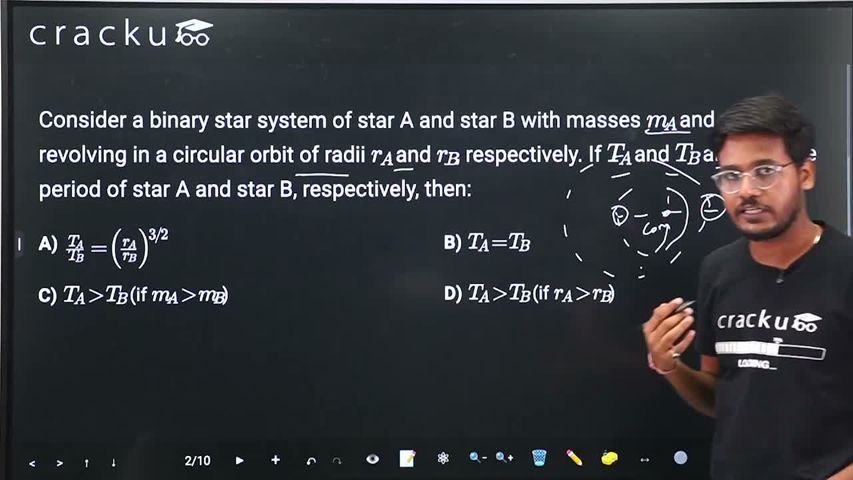
Consider a binary star system of star A and star B with masses $$m_A$$ and $$m_B$$ revolving in a circular orbit of radii $$r_A$$ and $$r_B$$, respectively. If $$T_A$$ and $$T_B$$ are the time period of star A and star B, respectively, then:
In a binary star system, both stars revolve around their common centre of mass. Crucially, both stars complete one full orbit in the same time — they always remain on opposite sides of the centre of mass. This is a direct consequence of Newton's third law: the gravitational force each exerts on the other is equal and opposite, and since they orbit the same centre of mass with the same angular velocity, their periods must be identical.
Although the orbital radii $$r_A$$ and $$r_B$$ may differ (depending on the mass ratio $$m_A r_A = m_B r_B$$), and $$r_A \neq r_B$$ in general, the angular velocity $$\omega$$ is the same for both, so $$T_A = T_B$$.
Therefore $$T_A = T_B$$.
Was this solution helpful?
Click on the Email ☝️ to Watch the Video Solution
Create a FREE account and get:
_1.webp)

Educational materials for JEE preparation

Ask our AI anything

AI can make mistakes. Please verify important information.
AI can make mistakes. Please verify important information.
