
Join Our JEE Preparation Group
Prep with like-minded aspirants; Get access to free daily tests and study material.
Sign in
Please select an account to continue using cracku.in
↓ →
Join Our JEE Preparation Group
Prep with like-minded aspirants; Get access to free daily tests and study material.
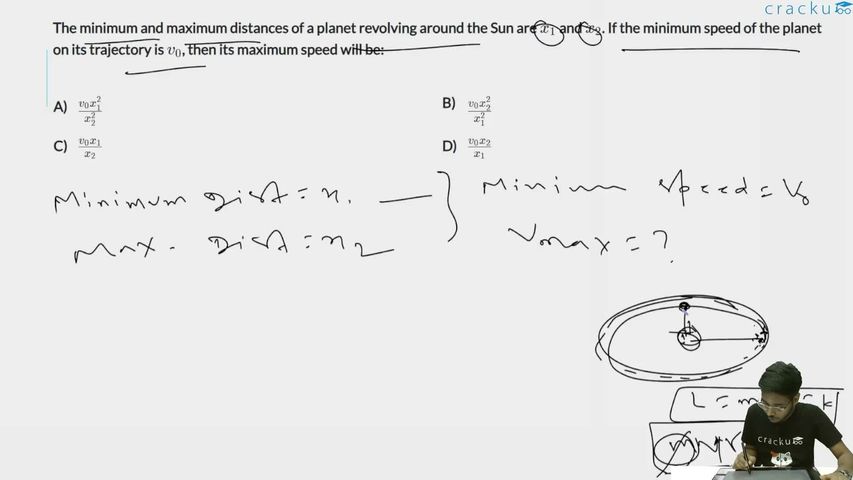
The minimum and maximum distances of a planet revolving around the Sun are $$x_1$$ and $$x_2$$. If the minimum speed of the planet on its trajectory is $$v_0$$, then its maximum speed will be:
We have a planet of mass $$m$$ revolving around the Sun under the action of the gravitational force. Because this force is always directed towards the Sun (the centre of force), it is a central force. For motion under a central force, the angular momentum about the centre remains conserved. We therefore begin with the statement of the law of conservation of angular momentum:
$$L \;=\; mvr \;=\; \text{constant}.$$
Here $$v$$ is the linear speed of the planet at any instant and $$r$$ is the corresponding Sun-planet distance. Since the mass $$m$$ of the planet does not change, the product $$vr$$ must stay the same at every point along the orbit.
The orbit is elliptical. Let
$$x_1 = \text{minimum distance (perihelion)},$$
$$x_2 = \text{maximum distance (aphelion)}.$$
At aphelion the distance is greatest, so the speed is least; this minimum speed is given to be $$v_0$$. At perihelion the distance is least, so the speed is greatest; let us call this unknown maximum speed $$v_{\max}$$. Using the conserved quantity $$mvr$$ at the two extreme positions:
$$m\,v_{\max}\,x_1 \;=\; m\,v_0\,x_2.$$
Now we cancel the common factor $$m$$ from both sides:
$$v_{\max}\,x_1 \;=\; v_0\,x_2.$$
To isolate $$v_{\max}$$ we divide both sides by $$x_1$$:
$$v_{\max} \;=\; \dfrac{v_0\,x_2}{x_1}.$$
This is the required expression for the maximum speed of the planet. Comparing with the given options, we notice that this matches option D.
Hence, the correct answer is Option D.
Was this solution helpful?
Click on the Email ☝️ to Watch the Video Solution
Create a FREE account and get:
_1.webp)

Educational materials for JEE preparation

Ask our AI anything

AI can make mistakes. Please verify important information.
AI can make mistakes. Please verify important information.
