
Join Our JEE Preparation Group
Prep with like-minded aspirants; Get access to free daily tests and study material.
Sign in
Please select an account to continue using cracku.in
↓ →
Join Our JEE Preparation Group
Prep with like-minded aspirants; Get access to free daily tests and study material.
Given below are two statements: one is labelled as Assertion A and the other is labelled as Reason R.
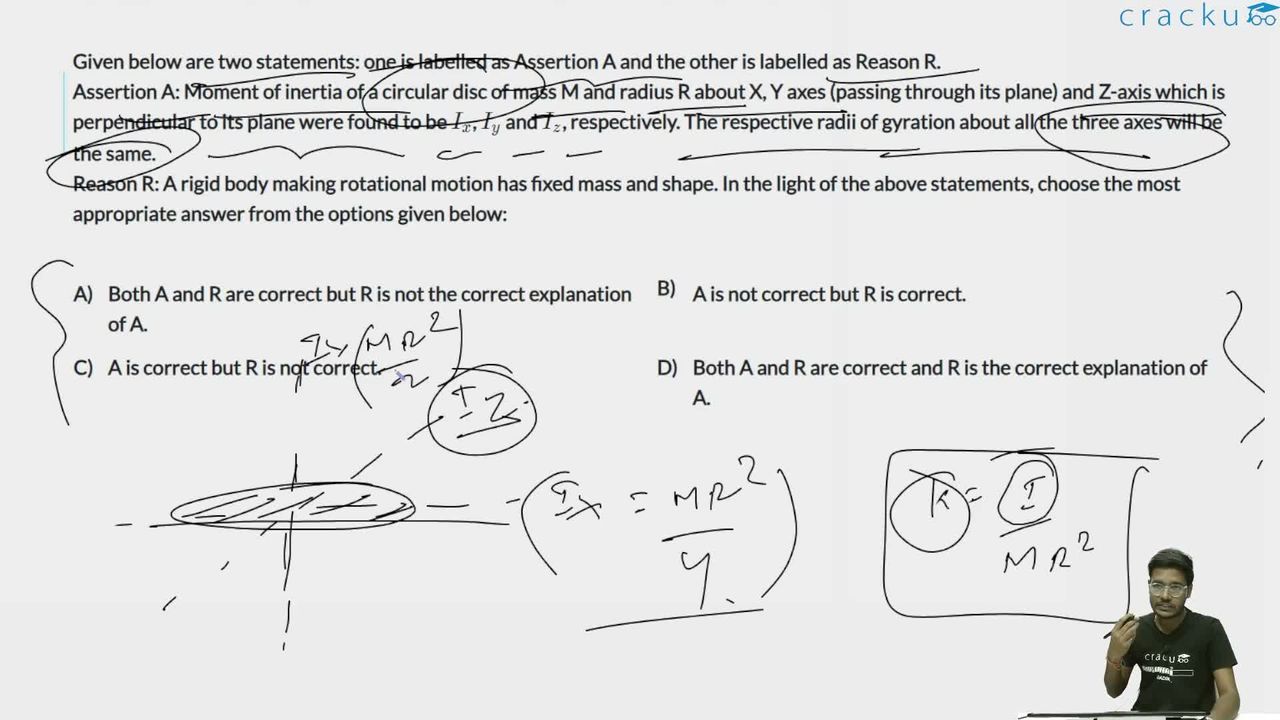
Assertion A: Moment of inertia of a circular disc of mass M and radius R about X, Y axes (passing through its plane) and Z-axis which is perpendicular to its plane were found to be $$I_x$$, $$I_y$$ and $$I_z$$, respectively. The respective radii of gyration about all the three axes will be the same.
Reason R: A rigid body making rotational motion has fixed mass and shape. In the light of the above statements, choose the most appropriate answer from the options given below:
We begin by recalling the definition of moment of inertia. For any rigid body about a given axis we write the relation
$$I = M\,k^{2}$$
where $$I$$ is the moment of inertia, $$M$$ is the total mass of the body, and $$k$$ is the radius of gyration about that axis. The radius of gyration therefore depends directly on the numerical value of the moment of inertia about the chosen axis.
Now we consider a uniform thin circular disc of mass $$M$$ and radius $$R$$. Its centre is the origin, its plane is the X-Y plane, so the Z-axis passes through its centre perpendicular to the plane. The X- and Y-axes are two mutually perpendicular diameters lying in the plane of the disc.
First, we write down the standard results for the moments of inertia of such a disc (these results can be obtained by integration, but are quoted here as standard):
$$$I_{Z} = \frac12\,M R^{2} \qquad\text{(about the Z-axis)}$$$
$$$I_{X} = I_{Y} = \frac14\,M R^{2} \qquad\text{(about any diameter in the plane, e.g. X or Y axis)}$$$
We next find the radii of gyration corresponding to each axis by substituting these values into the defining equation $$I = M\,k^{2}$$.
For the Z-axis we have
$$$k_{Z}^{2} = \frac{I_{Z}}{M} = \frac{\dfrac12\,M R^{2}}{M} = \frac12\,R^{2}$$$
so
$$k_{Z} = \sqrt{\frac12}\,R = \frac{R}{\sqrt2}\,.$$
For the X-axis we write
$$$k_{X}^{2} = \frac{I_{X}}{M} = \frac{\dfrac14\,M R^{2}}{M} = \frac14\,R^{2}$$$
and therefore
$$k_{X} = \sqrt{\frac14}\,R = \frac{R}{2}\,.$$
The Y-axis expression is identical because $$I_{Y} = I_{X}$$, giving
$$k_{Y} = \frac{R}{2}\,.$$
So we finally have
$$k_{X} = k_{Y} = \frac{R}{2}, \qquad k_{Z} = \frac{R}{\sqrt2}\,. $$
These three values are clearly not equal because
$$\frac{R}{2} \neq \frac{R}{\sqrt2}\,. $$
Therefore the assertion “the respective radii of gyration about all the three axes will be the same” is false.
We now examine the reason. The statement “A rigid body making rotational motion has fixed mass and shape” is always true; the mass and the geometrical size of a rigid body do not change during rotation. Hence the reason is a correct factual statement, although it has no logical connection with the equality (or inequality) of the radii of gyration.
We thus have: Assertion A is not correct, while Reason R is correct but does not explain A.
Hence, the correct answer is Option B.
Was this solution helpful?
Click on the Email ☝️ to Watch the Video Solution
Create a FREE account and get:
_1.webp)

Educational materials for JEE preparation

Ask our AI anything

AI can make mistakes. Please verify important information.
AI can make mistakes. Please verify important information.
