
Join Our JEE Preparation Group
Prep with like-minded aspirants; Get access to free daily tests and study material.
Sign in
Please select an account to continue using cracku.in
↓ →
Join Our JEE Preparation Group
Prep with like-minded aspirants; Get access to free daily tests and study material.
Two billiard balls of equal mass 30 g strike a rigid wall with same speed of 108 kmph (as shown) but at different angles. If the balls get reflected with the same speed, then the ratio of the magnitude of impulses imparted to ball a and ball b by the wall along X direction is:
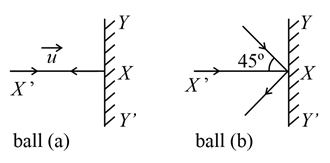
We need to determine the ratio of the magnitude of impulses imparted to ball a and ball b along the X-direction by a rigid wall.
According to the impulse-momentum theorem, the impulse ($\vec{J}$) imparted to an object is equal to its change in linear momentum ($\Delta \vec{p}$):
$$\vec{J} = \Delta \vec{p} = \vec{p}_f - \vec{p}_i$$
Since the question specifically asks for the impulse along the X-direction, we only need to look at the change in the horizontal component of velocity for each ball ($J_x = m \cdot \Delta v_x$). Let the initial speed of both balls be $u$.
From the diagram:
The change in velocity along the X-axis is:
$$\Delta v_{ax} = v_{fx} - v_{ix} = -u - u = -2u$$
The magnitude of the impulse for ball (a) is:
$$|J_a| = 2mu$$
From the diagram for ball (b):
The change in velocity along the X-axis is:
$$\Delta v_{bx} = v_{fx} - v_{ix} = -u \cos(45^\circ) - u \cos(45^\circ) = -2u \cos(45^\circ)$$
The magnitude of the impulse for ball (b) is:
$$|J_b| = 2mu \cos(45^\circ) = 2mu \left(\frac{1}{\sqrt{2}}\right) = \sqrt{2}mu$$
Now, we take the ratio of the two horizontal impulse magnitudes:
$$\frac{|J_a|}{|J_b|} = \frac{2mu}{\sqrt{2}mu} = \frac{2}{\sqrt{2}} = \frac{\sqrt{2}}{1}$$
The ratio of the magnitude of impulses along the X-direction is $$\sqrt{2} : 1$$, which corresponds exactly to Option B.
Was this solution helpful?
Create a FREE account and get:
_1.webp)

Educational materials for JEE preparation

Ask our AI anything

AI can make mistakes. Please verify important information.
AI can make mistakes. Please verify important information.
