
Join Our JEE Preparation Group
Prep with like-minded aspirants; Get access to free daily tests and study material.
Sign in
Please select an account to continue using cracku.in
↓ →
Join Our JEE Preparation Group
Prep with like-minded aspirants; Get access to free daily tests and study material.
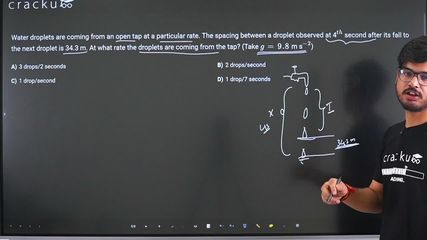
Water droplets are coming from an open tap at a particular rate. The spacing between a droplet observed at 4$$^{th}$$ second after its fall to the next droplet is 34.3 m. At what rate the droplets are coming from the tap? (Take $$g = 9.8$$ m s$$^{-2}$$)
Let us assume that every droplet leaves the tap after a fixed time-interval. We denote this interval by $$T\;{\rm s}$$ (seconds). Thus one droplet is released, after exactly $$T$$ seconds the next droplet is released, after the next $$T$$ seconds another droplet is released, and so on. The question is really asking for the value of $$T$$, because
Rate of release $$=\dfrac{\text{number of drops}}{\text{time}}=\dfrac{1}{T}\;{\rm drops\;per\;second}.$$
We now focus on two particular droplets:
• Droplet A has already been falling for $$4\;{\rm s}$$ at the instant we make our observation.
• Droplet B is the “next” droplet that left the tap after droplet A.
Because the tap releases drops every $$T$$ seconds, droplet B was released exactly $$T$$ seconds after droplet A.
Hence, at the same observation instant, droplet B has been in free-fall for only $$(4-T)\;{\rm s}.$$
Both droplets start from rest, so their motion is described by the standard free-fall formula
$$s=\dfrac12\,g\,t^{2},$$
where $$s$$ is the distance fallen in time $$t$$ and $$g=9.8\;{\rm m\,s^{-2}}$$. We now write the individual distances:
Distance fallen by droplet A: $$s_A=\dfrac12\,g\,(4)^{2}=\dfrac12\times 9.8 \times 16=78.4\;{\rm m}.$$
Distance fallen by droplet B: $$s_B=\dfrac12\,g\,(4-T)^{2}=4.9\,(4-T)^{2}\;{\rm m}.$$
The spacing between the two droplets is the difference of these two distances. According to the problem this spacing equals $$34.3\;{\rm m}$$, so we must have
$$s_A-s_B=34.3.$$
Substituting the explicit expressions of $$s_A$$ and $$s_B$$, we get
$$78.4-4.9\,(4-T)^{2}=34.3.$$
We now isolate the quadratic term step by step:
Subtract $$34.3$$ from $$78.4$$ on the left:
$$78.4-34.3 = 4.9\,(4-T)^{2}.$$
Compute the numerical difference:
$$44.1 = 4.9\,(4-T)^{2}.$$
Divide both sides by $$4.9$$ so that only the square remains on the right:
$$\dfrac{44.1}{4.9} = (4-T)^{2}.$$
Because $$44.1/4.9 = 9$$, we have
$$(4-T)^{2}=9.$$
To eliminate the square, take square roots on both sides:
$$4-T = \pm\,3.$$
This gives two possible linear equations:
1. $$4-T = 3 \quad\Longrightarrow\quad T = 1\;{\rm s},$$
2. $$4-T = -3 \quad\Longrightarrow\quad T = 7\;{\rm s}.$$
We must now decide which of these two values makes physical sense. Droplet B has been falling for $$(4-T)$$ seconds, and this time must be positive; otherwise the “next” droplet would not yet have left the tap. If we take $$T=7\;{\rm s}$$, then $$(4-T) = -3\;{\rm s},$$ which is impossible. Therefore we reject $$T=7\;{\rm s}$$ and accept
$$T = 1\;{\rm s}.$$
The rate at which droplets emerge is thus
$$\text{Rate} = \dfrac{1}{T} = \dfrac{1}{1}\;{\rm drop\;per\;second}.$$
Hence, the correct answer is Option 3.
Was this solution helpful?
Click on the Email ☝️ to Watch the Video Solution
Create a FREE account and get:
_1.webp)

Educational materials for JEE preparation

Ask our AI anything

AI can make mistakes. Please verify important information.
AI can make mistakes. Please verify important information.
