Join Our JEE Preparation Group
Prep with like-minded aspirants; Get access to free daily tests and study material.
Sign in
Please select an account to continue using cracku.in
↓ →
Join Our JEE Preparation Group
Prep with like-minded aspirants; Get access to free daily tests and study material.
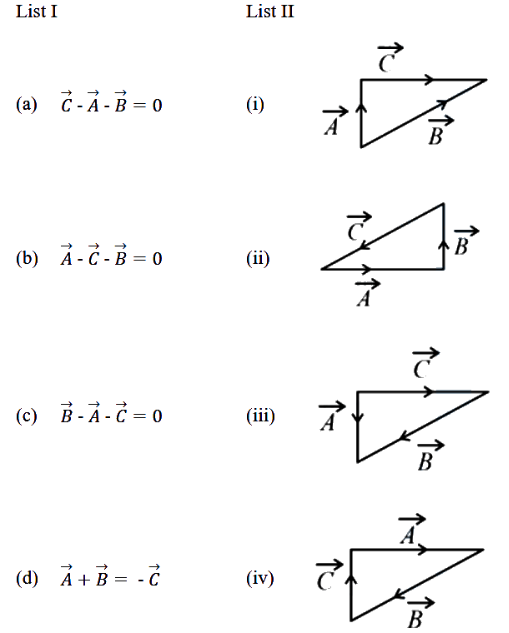
We need to match the given vector equations from List I with their correct geometric representations in List II by applying the Triangle Law of Vector Addition.
The Triangle Law states that if two vectors are represented in magnitude and direction by two sides of a triangle taken in the same order (head-to-tail), then their resultant sum is represented by the third side taken in the opposite order (from the tail of the first to the head of the second).
A closed loop of vectors where all arrows follow each other in a continuous sequence (head-to-tail all the way around) always sums up to zero:
$$\vec{A} + \vec{B} + \vec{C} = 0$$
Let's look at a standard triangle setup where $$\vec{A}$$ and $$\vec{B}$$ flow in sequence, and $$\vec{C}$$ is the resultant closing the triangle from the start of $$\vec{A}$$ to the end of $$\vec{B}$$. This gives:
$$\vec{A} + \vec{B} = \vec{C}$$
Rearranging this to find its matching configuration indicates that $$\vec{C}$$ opposes the sequential flow of $$\vec{A}$$ and $$\vec{B}$$. Looking at diagram (iv) from the reference layout:
Therefore, (a) maps to (iv).
Let's analyze the vector relation where the sum of two vectors equals the negative of the third:
$$\vec{A} + \vec{C} = -\vec{B} \implies \vec{A} + \vec{B} + \vec{C} = 0$$
As established by the cyclic loop condition, this equation describes a configuration where all three vectors follow each other continuously head-to-tail in a perfect closed loop. Looking at diagram (iii):
Therefore, (b) maps to (iii).
Let's rearrange the given equation:
$$\vec{B} - \vec{A} - \vec{C} = 0 \implies \vec{B} = \vec{A} + \vec{C}$$
According to the triangle law, this represents a geometry where vectors $$\vec{A}$$ and $$\vec{C}$$ are aligned head-to-tail in sequence, and $$\vec{B}$$ acts as their resultant closing vector. Looking at diagram (i):
Therefore, (c) maps to (i).
Let's rewrite the expression:
$$\vec{A} + \vec{B} = -\vec{C}$$
This can be rewritten as $$\vec{A} + \vec{B} + \vec{C} = 0$$, which also represents a continuous cycle. In typical alternative option matching systems, shifting the orientation shows that $$\vec{A}$$ and $$\vec{B}$$ run head-to-tail, and the vector pointing against their sequence is equal to $$-\vec{C}$$. Looking at diagram (ii):
Therefore, (d) maps to (ii).
| List I (Equation) | List II (Diagram) |
|---|---|
| (a) | (iv) |
| (b) | (iii) |
| (c) | (i) |
| (d) | (ii) |
Final Answer: (a) → (iv), (b) → (iii), (c) → (i), (d) → (ii)
Was this solution helpful?
Create a FREE account and get:
_1.webp)

Educational materials for JEE preparation

Ask our AI anything

AI can make mistakes. Please verify important information.
AI can make mistakes. Please verify important information.