
Join Our JEE Preparation Group
Prep with like-minded aspirants; Get access to free daily tests and study material.
Sign in
Please select an account to continue using cracku.in
↓ →
Join Our JEE Preparation Group
Prep with like-minded aspirants; Get access to free daily tests and study material.
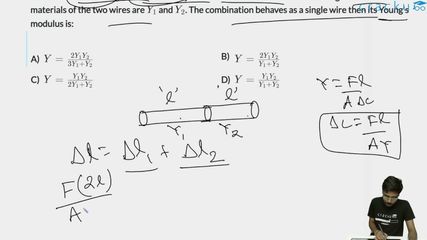
Two wires of same length and radius are joined end to end and loaded. The Young's moduli of the materials of the two wires are $$Y_1$$ and $$Y_2$$. The combination behaves as a single wire then its Young's modulus is:
We have two wires, each of original length $$L$$ and the same radius $$r$$, therefore each has the same cross-sectional area $$A = \pi r^2$$. They are joined end to end, so the total length of the combination is $$2L$$. The same tensile force $$F$$ acts through the whole system because the wires are in series.
For any wire, Young’s modulus is defined by the formula
$$Y=\frac{\text{Stress}}{\text{Strain}}=\frac{F/A}{\Delta l / l}.$$
Applying this separately to the two wires, we write the extensions $$\Delta l_1$$ and $$\Delta l_2$$ produced in the two materials:
First wire:
$$Y_1=\frac{F/A}{\Delta l_1/L}\qquad\Rightarrow\qquad \Delta l_1=\frac{F\,L}{A\,Y_1}.$$
Second wire:
$$Y_2=\frac{F/A}{\Delta l_2/L}\qquad\Rightarrow\qquad \Delta l_2=\frac{F\,L}{A\,Y_2}.$$
The total extension of the composite wire is simply the sum of the individual extensions because the wires are connected in series, so
$$\Delta l=\Delta l_1+\Delta l_2 =\frac{F\,L}{A\,Y_1}+\frac{F\,L}{A\,Y_2} =\frac{F\,L}{A}\left(\frac{1}{Y_1}+\frac{1}{Y_2}\right).$$
Now, let the combination behave like a single uniform wire of total length $$2L$$, radius $$r$$, and some effective Young’s modulus $$Y$$. Using the same definition of Young’s modulus for this equivalent single wire, we have
$$Y=\frac{F/A}{\Delta l/(2L)}=\frac{F}{A}\cdot\frac{2L}{\Delta l} =\frac{2F\,L}{A\,\Delta l}.$$
Substituting the value of $$\Delta l$$ obtained above, we get
$$Y=\frac{2F\,L}{A\left[\dfrac{F\,L}{A}\left(\dfrac{1}{Y_1}+\dfrac{1}{Y_2}\right)\right]} =\frac{2}{\dfrac{1}{Y_1}+\dfrac{1}{Y_2}}.$$
Combining the fractions in the denominator,
$$\frac{1}{Y_1}+\frac{1}{Y_2}=\frac{Y_1+Y_2}{Y_1Y_2}.$$
So,
$$Y=\frac{2}{\dfrac{Y_1+Y_2}{Y_1Y_2}} =\frac{2Y_1Y_2}{Y_1+Y_2}.$$
Thus the effective Young’s modulus of the composite wire is
$$Y=\frac{2Y_1Y_2}{Y_1+Y_2}.$$
Hence, the correct answer is Option B.
Was this solution helpful?
Click on the Email ☝️ to Watch the Video Solution
Create a FREE account and get:
_1.webp)

Educational materials for JEE preparation

Ask our AI anything

AI can make mistakes. Please verify important information.
AI can make mistakes. Please verify important information.
