
Join Our JEE Preparation Group
Prep with like-minded aspirants; Get access to free daily tests and study material.
Sign in
Please select an account to continue using cracku.in
↓ →
Join Our JEE Preparation Group
Prep with like-minded aspirants; Get access to free daily tests and study material.
Two different metal bodies A and B of equal mass are heated at a uniform rate under similar conditions. The variation of temperature of the bodies is graphically represented as shown in the figure. The ratio of specific heat capacities is:
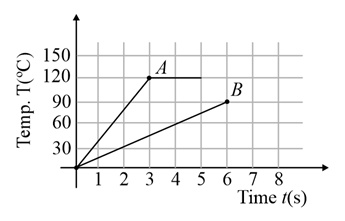
We know that the heat supplied per unit time is the power. If a body of mass $$m$$ is heated at a constant rate (power) $$P$$, then during a small interval of time $$dt$$ the heat given is $$dQ = P\,dt$$.
The calorimetric relation for a temperature rise says $$dQ = m\,c\,d\theta,$$ where $$c$$ is the specific heat capacity and $$d\theta$$ is the corresponding rise in temperature.
Substituting $$dQ = P\,dt$$ in the calorimetric relation, we obtain
$$P\,dt = m\,c\,d\theta.$$
Rearranging, the rate of rise of temperature becomes
$$\frac{d\theta}{dt} = \frac{P}{m\,c}.$$
The quantity $$\dfrac{d\theta}{dt}$$ is the slope of the temperature-time graph. Hence the slope $$S$$ of that graph is
$$S = \frac{P}{m\,c}.$$
For the two metal blocks A and B the mass $$m$$ and the heating power $$P$$ are identical, therefore
$$S \propto \frac{1}{c}\qquad\Longrightarrow\qquad c \propto \frac{1}{S}.$$
Thus the ratio of their specific heat capacities is the inverse ratio of the slopes:
$$\frac{c_A}{c_B} = \frac{S_B}{S_A}.$$
We now read the slopes directly from the straight-line portions of the given graph. Choosing the first $$4\ \text{min}$$ interval (any convenient interval gives the same result):
For body A the temperature rises from $$20^{\circ}\text{C}$$ to $$60^{\circ}\text{C},$$ so
$$\Delta\theta_A = 60 - 20 = 40^{\circ}\text{C}, \qquad \Delta t = 4\ \text{min},$$
and hence
$$S_A = \frac{\Delta\theta_A}{\Delta t} = \frac{40}{4} = 10^{\circ}\text{C}\,\text{min}^{-1}.$$
During the same time the temperature of body B rises from $$20^{\circ}\text{C}$$ to $$35^{\circ}\text{C},$$ giving
$$\Delta\theta_B = 35 - 20 = 15^{\circ}\text{C},$$
so that
$$S_B = \frac{\Delta\theta_B}{\Delta t} = \frac{15}{4} = 3.75^{\circ}\text{C}\,\text{min}^{-1}.$$
Taking their ratio,
$$\frac{S_B}{S_A} = \frac{15/4}{40/4} = \frac{15}{40} = \frac{3}{8}.$$
Substituting this into $$\dfrac{c_A}{c_B} = \dfrac{S_B}{S_A}$$ gives
$$\frac{c_A}{c_B} = \frac{3}{8}.$$
Hence, the correct answer is Option B.
Was this solution helpful?
Create a FREE account and get:
_1.webp)

Educational materials for JEE preparation

Ask our AI anything

AI can make mistakes. Please verify important information.
AI can make mistakes. Please verify important information.
