
Join Our JEE Preparation Group
Prep with like-minded aspirants; Get access to free daily tests and study material.
Sign in
Please select an account to continue using cracku.in
↓ →
Join Our JEE Preparation Group
Prep with like-minded aspirants; Get access to free daily tests and study material.
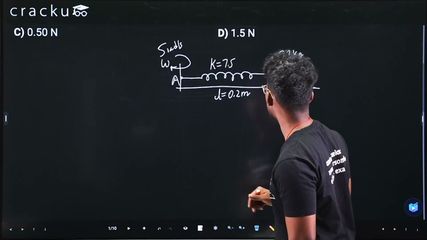
A small block of mass 100 g is tied to a spring of spring constant 7.5 N m$$^{-1}$$ and length 20 cm. The other end of spring is fixed at a particular point A. If the block moves in a circular path on a smooth horizontal surface with constant angular velocity 5 rad s$$^{-1}$$ about point A, then tension in the spring is
We have a mass $$m = 100\;\text{g} = 0.1\;\text{kg}$$ attached to a spring of constant $$k = 7.5\;\text{N/m}$$ and natural length $$L_0 = 20\;\text{cm} = 0.2\;\text{m}$$, rotating with angular velocity $$\omega = 5\;\text{rad/s}$$.
Let the extension of the spring be $$x$$. The total radius of the circular path is $$r = L_0 + x$$. The spring force provides the centripetal force (since the restoring force of the spring is what keeps the mass in circular motion), so
$$kx = m\omega^2(L_0 + x)$$
Rearranging to isolate $$x$$:
$$kx - m\omega^2 x = m\omega^2 L_0$$
$$x(k - m\omega^2) = m\omega^2 L_0$$
Now substituting the values:
$$x(7.5 - 0.1 \times 25) = 0.1 \times 25 \times 0.2$$
$$x(7.5 - 2.5) = 0.5$$
$$x \times 5 = 0.5$$
$$x = 0.1\;\text{m}$$
So the tension in the spring is $$T = kx = 7.5 \times 0.1 = 0.75\;\text{N}$$. Hence, the correct answer is 0.75 N.
Was this solution helpful?
Click on the Email ☝️ to Watch the Video Solution
Create a FREE account and get:
_1.webp)

Educational materials for JEE preparation

Ask our AI anything

AI can make mistakes. Please verify important information.
AI can make mistakes. Please verify important information.
