For the following questions answer them individually
Two resistances are given as $$R_1 = (10 \pm 0.5)$$ $$\Omega$$ and $$R_2 = (15 \pm 0.5)$$ $$\Omega$$. The percentage error in the measurement of equivalent resistance when they are connected in parallel is
A particle is moving with constant speed in a circular path. When the particle turns by an angle 90°, the ratio of instantaneous velocity to its average velocity is $$\pi : x\sqrt{2}$$. The value of $$x$$ will be
Given below are two statements: one is labelled as Assertion A and the other is labelled as Reason R.
Assertion A: When a body is projected at an angle 45°, its range is maximum.
Reason R: For maximum range, the value of sin 2$$\theta$$ should be equal to one.
In the light of the above statements, choose the correct answer from the options given below:
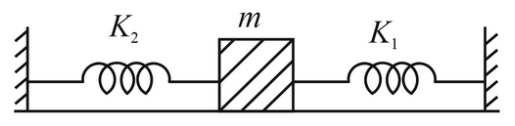
A mass $$m$$ is attached to two springs as shown in figure. The spring constants of two springs are $$K_1$$ and $$K_2$$. For the frictionless surface, the time period of oscillation of mass $$m$$ is
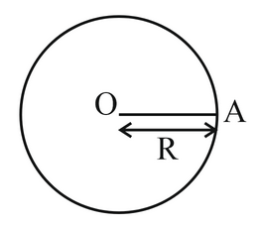
A small block of mass 100 g is tied to a spring of spring constant 7.5 N m$$^{-1}$$ and length 20 cm. The other end of spring is fixed at a particular point A. If the block moves in a circular path on a smooth horizontal surface with constant angular velocity 5 rad s$$^{-1}$$ about point A, then tension in the spring is
A planet has double the mass of the earth. Its average density is equal to that of the earth. An object weighing $$W$$ on earth will weigh on that planet:
Given below are two statements: one is labelled as Assertion A and the other is labelled as Reason R.
Assertion A: Earth has atmosphere whereas moon doesn't have any atmosphere.
Reason R: The escape velocity on moon is very small as compared to that on earth.
In the light of the above statements, choose the correct answer from the options given below:
A small ball of mass $$M$$ and density $$\rho$$ is dropped in a viscous liquid of density $$\rho_0$$. After some time, the ball falls with a constant velocity. What is the viscous force on the ball?
A source supplies heat to a system at the rate of 1000 W. If the system performs work at a rate of 200 W. The rate at which internal energy of the system increases is
The number of air molecules per cm$$^3$$ is increased from $$3 \times 10^{19}$$ to $$12 \times 10^{19}$$. The ratio of collision frequency of air molecules before and after the increase in number respectively is: