
Join Our JEE Preparation Group
Prep with like-minded aspirants; Get access to free daily tests and study material.
Sign in
Please select an account to continue using cracku.in
↓ →
Join Our JEE Preparation Group
Prep with like-minded aspirants; Get access to free daily tests and study material.
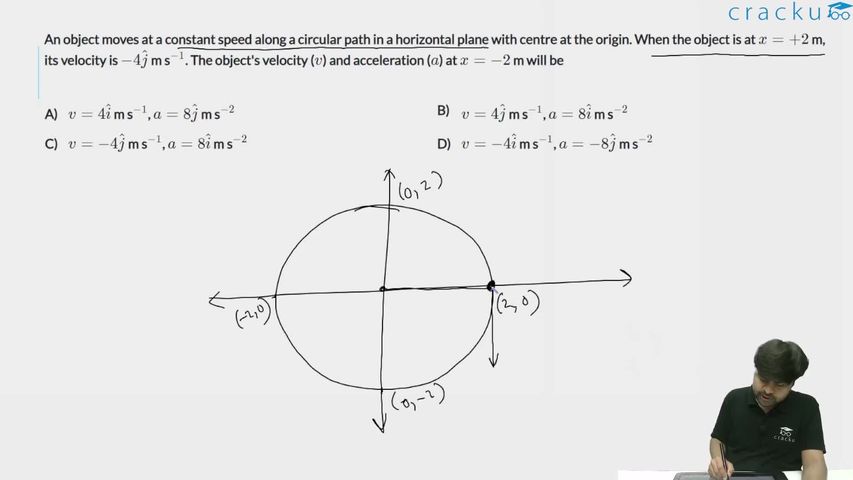
An object moves at a constant speed along a circular path in a horizontal plane with centre at the origin. When the object is at $$x = +2$$ m, its velocity is $$-4\hat{j}$$ m s$$^{-1}$$. The object's velocity ($$v$$) and acceleration ($$a$$) at $$x = -2$$ m will be
The object is in uniform circular motion with a radius of $$r=+2$$ meters (since it happens to be at $$x=+2$$ at an instant when the center of the motion is origin). At $$x=+2$$ meters, the velocity $$\vec{v}$$ is $$-4\hat{j}$$ m/s. This indicates that the object is moving clockwise.
Thus, at $$x=-2$$ meters, the velocity vector will be equal in magnitude but opposite in direction, and will therefore be $$\vec{v'} = 4\hat{j}$$.
Furthermore, the magnitude of acceleration at $$x=-2$$ will be given by $$a= \dfrac{v^2}{r} = \dfrac{4^2}{2} = \dfrac{16}{2} = 8 m/s^2$$
And the direction at $$x=-2$$ will be towards the origin (centripetal force), i.e. along $$+\hat{i}$$, thus, we have, $$\vec{a}=8\hat{i}$$.
Option B is the correct answer.
Was this solution helpful?
Click on the Email ☝️ to Watch the Video Solution
Create a FREE account and get:
_1.webp)

Educational materials for JEE preparation

Ask our AI anything

AI can make mistakes. Please verify important information.
AI can make mistakes. Please verify important information.
