
Join Our JEE Preparation Group
Prep with like-minded aspirants; Get access to free daily tests and study material.
Sign in
Please select an account to continue using cracku.in
↓ →
Join Our JEE Preparation Group
Prep with like-minded aspirants; Get access to free daily tests and study material.
An ideal fluid of density $$800$$ kg m$$^{-3}$$, flows smoothly through a bent pipe (as shown in the figure) that tapers in cross-sectional area from $$a$$ to $$\frac{a}{2}$$. The pressure difference between the wide and narrow sections of pipe is $$4100$$ Pa. At the wider section, the velocity of the fluid is $$\frac{\sqrt{x}}{6}$$ m s$$^{-1}$$ for $$x =$$ ______. (Given $$g = 10$$ m s$$^{-2}$$)
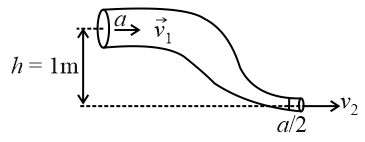
Correct Answer: 363
The product of cross-sectional area and velocity remains constant: $$A_1 v_1 = A_2 v_2$$
$$a \cdot v_1 = \left(\frac{a}{2}\right) \cdot v_2 \implies v_2 = 2v_1$$
Applying Bernoulli's equation between the wider section (point 1) and the narrow section (point 2):
$$P_1 + \frac{1}{2}\rho v_1^2 + \rho g h_1 = P_2 + \frac{1}{2}\rho v_2^2 + \rho g h_2$$
Let the reference level be at point 2 ($$h_2 = 0$$). Then $$h_1 = 1 \text{ m}$$
$$(P_1 - P_2) + \rho g h_1 = \frac{1}{2}\rho(v_2^2 - v_1^2)$$
Substitute the given values ($$\Delta P = 4100 \text{ Pa}$$, $$\rho = 800 \text{ kg m}^{-3}$$, $$g = 10 \text{ m s}^{-2}$$, $$v_2 = 2v_1$$)
$$4100 + (800 \cdot 10 \cdot 1) = \frac{1}{2} \cdot 800 \cdot [(2v_1)^2 - v_1^2]$$
$$4100 + 8000 = 400 \cdot (3v_1^2)$$
$$v_1^2 = \frac{12100}{1200} = \frac{121}{12}$$
$$v_1 = \sqrt{\frac{121}{12}} = \frac{11}{\sqrt{12}} = \frac{11}{2\sqrt{3}}$$
$$ = \frac{\sqrt{363}}{6}$$
x = 363
Was this solution helpful?
Create a FREE account and get:
_1.webp)

Educational materials for JEE preparation

Ask our AI anything

AI can make mistakes. Please verify important information.
AI can make mistakes. Please verify important information.
