For the following questions answer them individually
An expression for a dimensionless quantity $$P$$ is given by $$P = \frac{\alpha}{\beta} \log_e\left(\frac{kT}{\beta x}\right)$$; where $$\alpha$$ and $$\beta$$ are constants, $$x$$ is distance; $$k$$ is Boltzmann constant and $$T$$ is the temperature. Then the dimensions of $$\alpha$$ will be
A person is standing in an elevator. In which situation, he experiences weight loss?
An object is thrown vertically upwards. At its maximum height, which of the following quantity becomes zero?
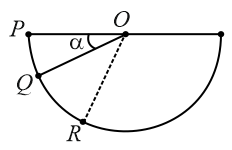
A ball is released from rest from point $$P$$ of a smooth semi-spherical vessel as shown in figure. The ratio of the centripetal force and normal reaction on the ball at point $$Q$$ is $$A$$ while angular position of point $$Q$$ is $$\alpha$$ with respect to point $$P$$. Which of the following graphs represent the correct relation between $$A$$ and $$\alpha$$ when ball goes from $$Q$$ to $$R$$?
A thin circular ring of mass $$M$$ and radius $$R$$ is rotating with a constant angular velocity $$2$$ rad s$$^{-1}$$ in a horizontal plane about an axis vertical to its plane and passing through the center of the ring. If two objects each of mass $$m$$ be attached gently to the opposite ends of a diameter of ring, the ring will then rotate with an angular velocity (in rad s$$^{-1}$$).
The variation of acceleration due to gravity $$(g)$$ with distance $$(r)$$ from the center of the earth is correctly represented by (Given $$R$$ = radius of earth)
The efficiency of a Carnot's engine, working between steam point and ice point, will be
A thermally insulated vessel contains an ideal gas of molecular mass $$M$$ and ratio of specific heats $$1.4$$. Vessel is moving with speed $$v$$ and is suddenly brought to rest. Assuming no heat is lost to the surrounding and vessel temperature of the gas increases by :
($$R$$ = universal gas constant)
Time period of a simple pendulum in a stationary lift is $$T$$. If the lift accelerates with $$\frac{g}{6}$$ vertically upwards then the time period will be
(Where $$g$$ = acceleration due to gravity)
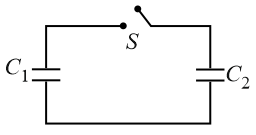
Two capacitors having capacitance $$C_1$$ and $$C_2$$ respectively are connected as shown in figure. Initially, capacitor $$C_1$$ is charged to a potential difference $$V$$ volt by a battery. The battery is then removed and the charged capacitor $$C_1$$ is now connected to uncharged capacitor $$C_2$$ by closing the switch $$S$$. The amount of charge on the capacitor $$C_2$$, after equilibrium, is