
Join Our JEE Preparation Group
Prep with like-minded aspirants; Get access to free daily tests and study material.
Sign in
Please select an account to continue using cracku.in
↓ →
Join Our JEE Preparation Group
Prep with like-minded aspirants; Get access to free daily tests and study material.
A square hole of side length $$\ell$$ is made at a depth of $$h$$ and a circular hole of radius $$r$$ is made at a depth of $$4h$$ from the surface of water in a water tank kept on a horizontal surface. If $$\ell << h, r << h$$ and the rate of water flow from the holes is the same, then $$r$$ is equal to
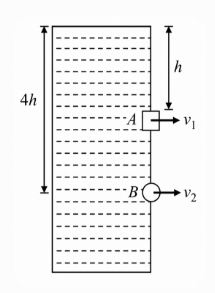
Torricelli's law gives the velocity of efflux from a hole at depth $$H$$ as $$v = \sqrt{2gH}$$, and the rate of volume flow is given by the equation of continuity $$Q = Av$$.
Given: $$A_{\text{square}} = l^2,\quad H_{\text{square}} = h$$ and $$A_{\text{circle}} = \pi r^2,\quad H_{\text{circle}} = 4h$$
Equating the volume flow rates ($$Q_1 = Q_2$$):
$$A_{\text{square}} v_1 = A_{\text{circle}} v_2$$
$$l^2 \sqrt{2gh} = \pi r^2 \sqrt{2g(4h)}$$
$$l^2 \sqrt{2gh} = \pi r^2 \cdot 2\sqrt{2gh}$$
$$l^2 = 2\pi r^2$$
$$r^2 = \frac{l^2}{2\pi} \implies r = \frac{l}{\sqrt{2\pi}}$$
Was this solution helpful?
Create a FREE account and get:
_1.webp)

Educational materials for JEE preparation

Ask our AI anything

AI can make mistakes. Please verify important information.
AI can make mistakes. Please verify important information.
