
Join Our JEE Preparation Group
Prep with like-minded aspirants; Get access to free daily tests and study material.
Sign in
Please select an account to continue using cracku.in
↓ →
Join Our JEE Preparation Group
Prep with like-minded aspirants; Get access to free daily tests and study material.
In the diagram shown, the difference in the two tubes of the manometer is 5 cm, the cross-section of the tube at A and B is 6 mm$$^2$$ and 10 mm$$^2$$ respectively. The rate at which water flows through the tube is (g = 10 m s$$^{-2}$$)
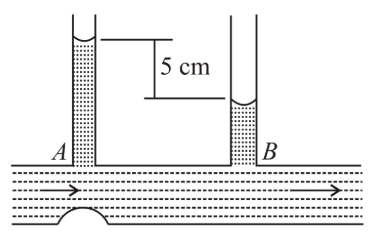
The pressure difference between the two points is determined by the height difference $$\Delta h = 5\text{ cm}$$ in the manometer:
$$\Delta P = \rho g \Delta h = 1\text{ g/cc} \times 10^3\text{ cm/s}^2 \times 5\text{ cm} = 5 \times 10^3\text{ dyne/cm}^2$$
Using the equation of continuity $$A_1v_1 = A_2v_2$$: $$6v_A = 10v_B \implies v_A = \frac{5}{3}v_B$$
Substituting this into Bernoulli's equation, $$\frac{1}{2}\rho(v_A^2 - v_B^2) = P_B - P_A$$:
$$\frac{1}{2} \times 1 \left[ \left(\frac{5}{3}v_B\right)^2 - v_B^2 \right] = 5 \times 10^3$$
$$\frac{1}{2} \left( \frac{16}{9}v_B^2 \right) = 5 \times 10^3 \implies v_B = \frac{3}{4} \times 10^2\text{ cm/s}$$
$$\text{Volume flow rate} = v_B A_B = \left(\frac{3}{4} \times 10^2\right) \times (10 \times 10^{-2}) = 7.5\text{ cc/s}$$
Was this solution helpful?
Create a FREE account and get:
_1.webp)

Educational materials for JEE preparation

Ask our AI anything

AI can make mistakes. Please verify important information.
AI can make mistakes. Please verify important information.
