For the following questions answer them individually
A bullet loses $$\left(\frac{1}{n}\right)^{th}$$ of its velocity passing through one plank. Considering uniform retardation, the number of such planks that are required to stop the bullet can be:
A heavy box is to be dragged along a rough horizontal floor. To do so, the person A pushes it at an angle 30° from the horizontal and requires a minimum force $$F_A$$, while the person B pulls the box at an angle 60° from the horizontal and needs minimum force $$F_B$$. If the coefficient of friction between the box and the floor is $$\frac{\sqrt{3}}{5}$$, the ratio $$\frac{F_A}{F_B}$$ is:
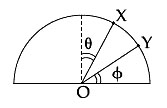
A particle is released on a vertical smooth semicircular track from point X so that, OX makes angle $$\theta$$ from the vertical (see figure). The normal reaction of the track on the particle vanishes at the point Y where OY makes an angle $$\phi$$ with the horizontal. Then:
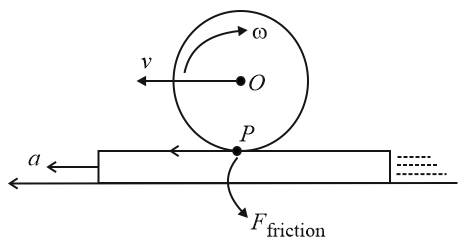
Consider a cylinder of mass M resting on a rough horizontal rug that is pulled out from under it with acceleration 'a' perpendicular to the axis of the cylinder. What is $$F_{friction}$$ at point P? It is assumed that the cylinder does not slip.
A ball of mass 160 g is thrown up at an angle of 60° to the horizontal at a speed of 10 m s$$^{-1}$$. The angular momentum of the ball at the highest point of the trajectory with respect to the point from which the ball is thrown is nearly (g = 10 m s$$^{-2}$$)
Match List-I (Event) with List-II (Order of the time interval for the happening of the event) and select the correct option from the options given below the lists.
List-I:Â Â Â Â Â Â Â Â Â Â Â Â Â Â Â Â Â Â Â Â Â Â Â Â Â Â Â Â Â Â Â Â List-II:
(a) The rotation period of earth        (i) 10$$^5$$ s
(b) Revolution period of earth        (ii) 10$$^7$$ s
(c) Period of a light wave            (iii) 10$$^{-15}$$ s
(d) Period of a sound wave          (iv) 10$$^{-3}$$ s
The gravitational field in a region is given by $$\vec{g} = (5\hat{i} + 12\hat{j})$$ N kg$$^{-1}$$. The change in the gravitational potential energy of a particle of mass 2 kg when it is taken from the origin to a point (7 m, $$-3$$ m) is:
The velocity of water in a river is 18 km h$$^{-1}$$ near the surface. If the river is 5 m deep, find the shearing stress between the horizontal layers of water. The coefficient of viscosity of water = $$10^{-2}$$ poise.
A large number of liquid drops each of radius r coalesce to form a single drop of the radius R. The energy released in the process is converted into kinetic energy of the big drop so formed. The speed of the big drop is (given surface tension of the liquid T, density $$\rho$$)
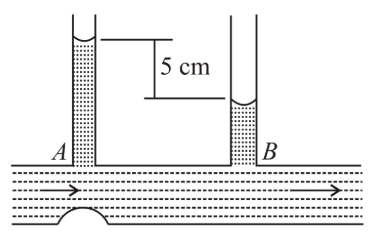
In the diagram shown, the difference in the two tubes of the manometer is 5 cm, the cross-section of the tube at A and B is 6 mm$$^2$$ and 10 mm$$^2$$ respectively. The rate at which water flows through the tube is (g = 10 m s$$^{-2}$$)