
Join Our JEE Preparation Group
Prep with like-minded aspirants; Get access to free daily tests and study material.
Sign in
Please select an account to continue using cracku.in
↓ →
Join Our JEE Preparation Group
Prep with like-minded aspirants; Get access to free daily tests and study material.
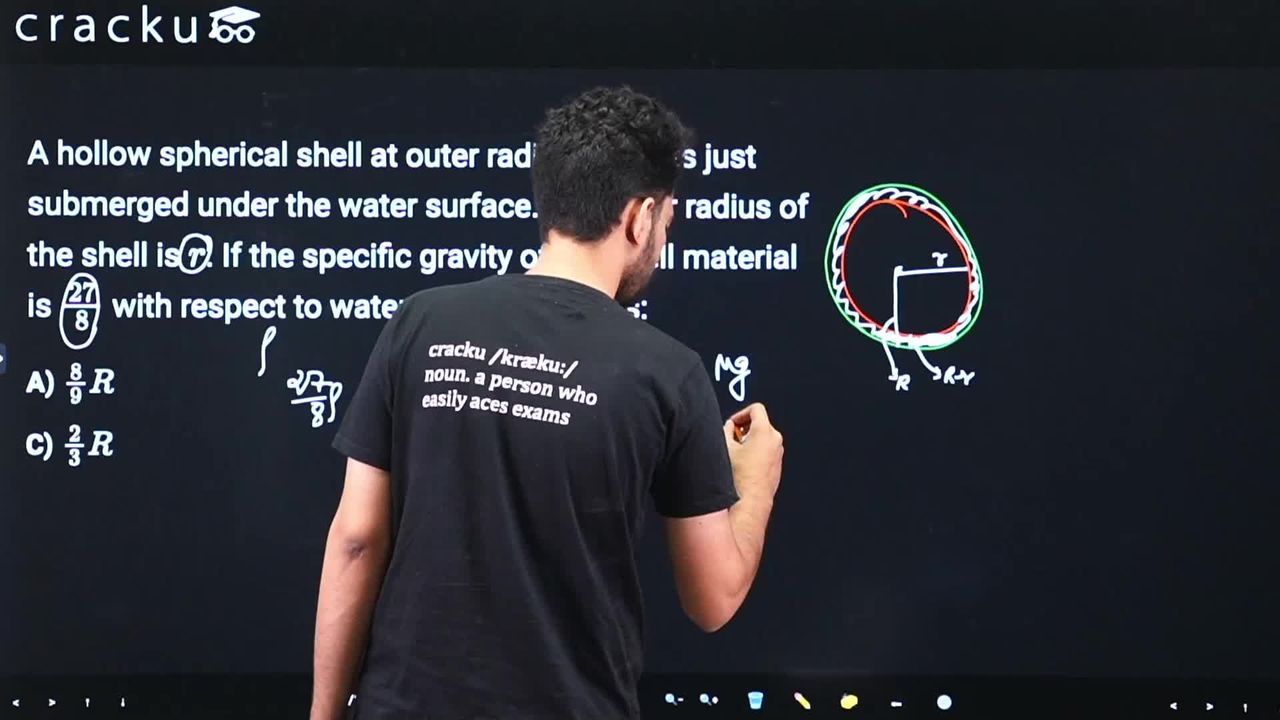
A hollow spherical shell at outer radius $$R$$ floats just submerged under the water surface. The inner radius of the shell is $$r$$. If the specific gravity of the shell material is $$\frac{27}{8}$$ with respect to water, the value of $$r$$ is:
We have a thin‐walled hollow sphere whose outer radius is $$R$$ and inner radius is $$r$$. Its material has specific gravity $$\dfrac{27}{8}$$ with respect to water. Specific gravity is defined as
$$\text{specific gravity}=\dfrac{\text{density of substance}}{\text{density of water}}.$$
So, if we denote the density of water by $$\rho$$, the density of the shell material is
$$\rho_{\!s}=\dfrac{27}{8}\,\rho.$$
Because the sphere floats just submerged, the whole external volume $$\left(\dfrac{4}{3}\pi R^{3}\right)$$ is under water. According to Archimedes’ principle, the buoyant force equals the weight of the water displaced, i.e.
$$F_{\text{buoyant}}=\rho\,g\left(\dfrac{4}{3}\pi R^{3}\right).$$
The weight of the body that must be supported is simply the weight of the shell material (the air inside has negligible mass). Its volume is the difference between the outer and inner volumes, so
$$F_{\text{weight}}=\rho_{\!s}\,g\left[\dfrac{4}{3}\pi\left(R^{3}-r^{3}\right)\right]=\dfrac{27}{8}\rho\,g\left[\dfrac{4}{3}\pi\left(R^{3}-r^{3}\right)\right].$$
For floating equilibrium we set buoyant force equal to weight:
$$\rho\,g\left(\dfrac{4}{3}\pi R^{3}\right)=\dfrac{27}{8}\rho\,g\left[\dfrac{4}{3}\pi\left(R^{3}-r^{3}\right)\right].$$
Now we cancel the common factors $$\rho,\,g,$$ and $$\dfrac{4}{3}\pi$$ from both sides:
$$R^{3}=\dfrac{27}{8}\left(R^{3}-r^{3}\right).$$
Multiplying through by $$8$$ gives
$$8R^{3}=27\left(R^{3}-r^{3}\right).$$
Expanding the right-hand side,
$$8R^{3}=27R^{3}-27r^{3}.$$
Rearranging to isolate $$r^{3},$$
$$27r^{3}=27R^{3}-8R^{3}=19R^{3},$$
hence
$$r^{3}=\dfrac{19}{27}R^{3}.$$
Taking the cube root of both sides we obtain
$$\dfrac{r}{R}=\left(\dfrac{19}{27}\right)^{1/3}\approx0.889.$$
The numerical value $$0.889$$ is practically equal to $$\dfrac{8}{9}=0.888\dots$$ Therefore,
$$r\;\approx\;\dfrac{8}{9}R.$$
Among the alternatives, this matches Option A.
Hence, the correct answer is Option A.
Was this solution helpful?
Click on the Email ☝️ to Watch the Video Solution
Create a FREE account and get:
_1.webp)

Educational materials for JEE preparation

Ask our AI anything

AI can make mistakes. Please verify important information.
AI can make mistakes. Please verify important information.


