
Join Our JEE Preparation Group
Prep with like-minded aspirants; Get access to free daily tests and study material.
Sign in
Please select an account to continue using cracku.in
↓ →
Join Our JEE Preparation Group
Prep with like-minded aspirants; Get access to free daily tests and study material.
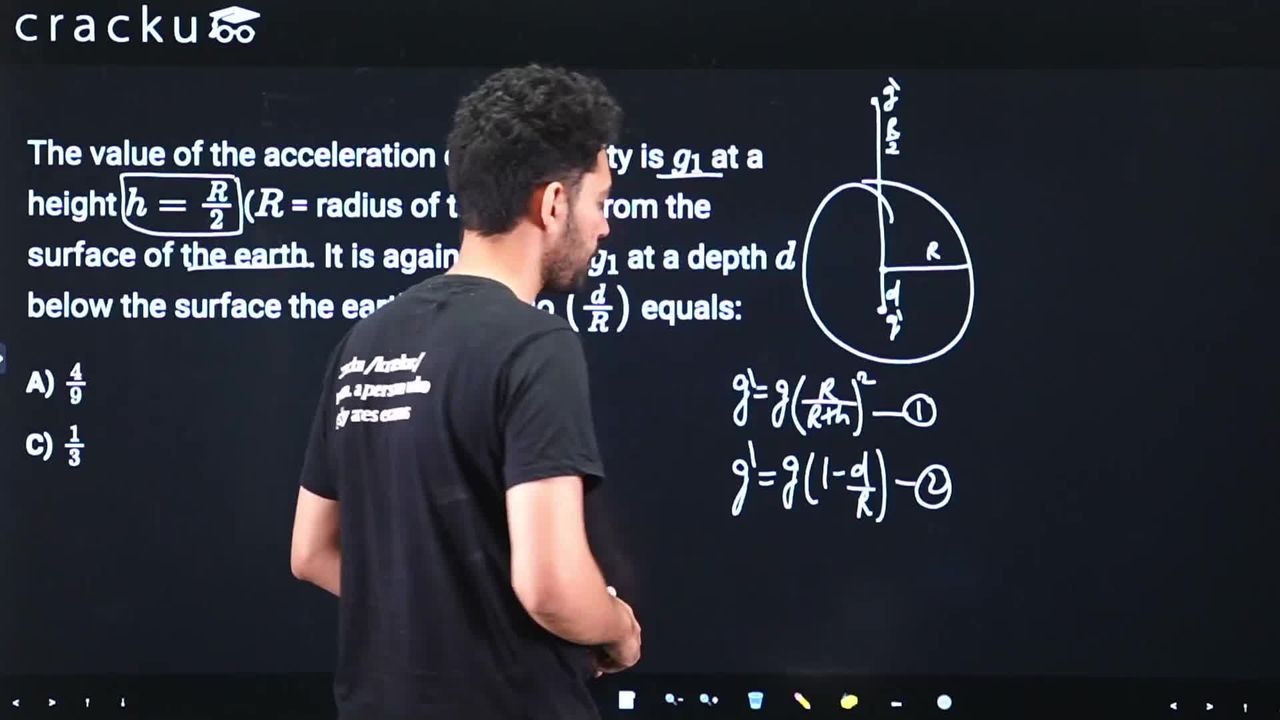
The value of the acceleration due to gravity is $$g_1$$ at a height $$h = \frac{R}{2}$$ ($$R$$ = radius of the earth) from the surface of the earth. It is again equal to $$g_1$$ at a depth $$d$$ below the surface the earth. The ratio $$\left(\frac{d}{R}\right)$$ equals:
Let $$g$$ denote the acceleration due to gravity at the surface of the Earth. We need the expressions for gravity when we go up to a height and when we go down to a depth.
First, the standard relation for acceleration due to gravity at a height $$h$$ above the surface is stated as $$g_h = g\left(\frac{R}{R+h}\right)^2.$$ This follows from Newton’s law of gravitation, because the distance of the mass from the centre becomes $$R+h$$ and the force is inversely proportional to the square of that distance.
Second, the standard relation for acceleration due to gravity at a depth $$d$$ below the surface is stated as $$g_d = g\left(1-\frac{d}{R}\right).$$ Inside the Earth the gravitational field falls off linearly with distance from the centre, giving this simple linear reduction factor.
According to the question we are given that the value of gravity at height $$h = \dfrac{R}{2}$$ equals the same value at some depth $$d$$. So we write $$g_h = g_d.$$
Substituting the formulae, we have $$g\left(\frac{R}{R+\dfrac{R}{2}}\right)^2 = g\left(1-\frac{d}{R}\right).$$
Now we simplify the left-hand side step by step. The denominator inside the parentheses is $$R + \frac{R}{2} = \frac{3R}{2}.$$ So inside the square we get $$\frac{R}{\dfrac{3R}{2}} = \frac{R}{1}\times \frac{2}{3R} = \frac{2}{3}.$$
Squaring this fraction, $$\left(\frac{2}{3}\right)^2 = \frac{4}{9}.$$ Hence the left-hand side becomes $$g \times \frac{4}{9}.$$
The equation thus reduces to $$g\left(\frac{4}{9}\right) = g\left(1-\frac{d}{R}\right).$$
We can cancel the common factor $$g$$ on both sides, giving $$\frac{4}{9} = 1-\frac{d}{R}.$$
Now we isolate the ratio $$\dfrac{d}{R}$$. Transposing the fraction yields $$\frac{d}{R} = 1 - \frac{4}{9}.$$
Writing the right-hand side with a common denominator, $$1 = \frac{9}{9},$$ so $$\frac{d}{R} = \frac{9}{9} - \frac{4}{9} = \frac{5}{9}.$$
Thus the required ratio is $$\boxed{\dfrac{d}{R} = \dfrac{5}{9}}.$$
Hence, the correct answer is Option B.
Was this solution helpful?
Click on the Email ☝️ to Watch the Video Solution
Create a FREE account and get:
_1.webp)

Educational materials for JEE preparation

Ask our AI anything

AI can make mistakes. Please verify important information.
AI can make mistakes. Please verify important information.


