
Join Our JEE Preparation Group
Prep with like-minded aspirants; Get access to free daily tests and study material.
Sign in
Please select an account to continue using cracku.in
↓ →
Join Our JEE Preparation Group
Prep with like-minded aspirants; Get access to free daily tests and study material.
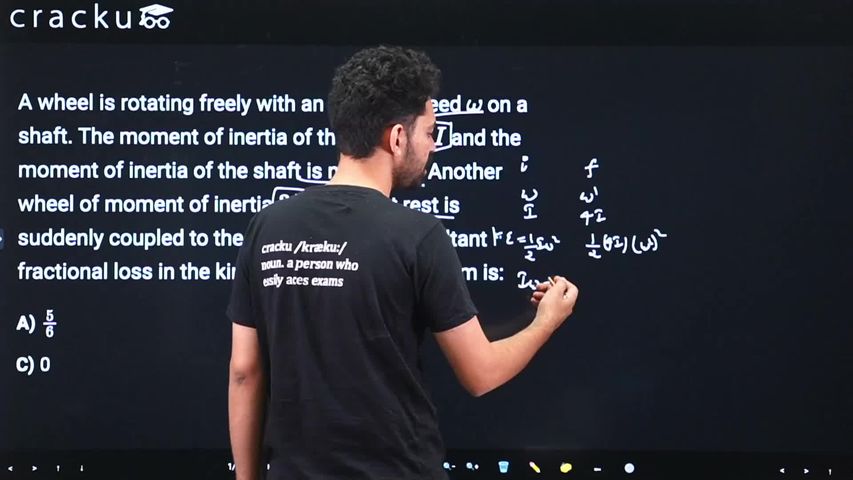
A wheel is rotating freely with an angular speed $$\omega$$ on a shaft. The moment of inertia of the wheel is $$I$$ and the moment of inertia of the shaft is negligible. Another wheel of moment of inertia $$3I$$ initially at rest is suddenly coupled to the same shaft. The resultant fractional loss in the kinetic energy of the system is:
We have a wheel of moment of inertia $$I$$ spinning freely with angular speed $$\omega$$ on a shaft whose own moment of inertia is negligible. The rotational kinetic energy initially stored in this wheel is given by the well-known formula for rotational kinetic energy
$$K = \tfrac12 I \omega^2.$$
So, the initial angular momentum and kinetic energy of the system are, respectively,
$$L_{\text{initial}} = I\,\omega,$$
$$K_{\text{initial}} = \tfrac12\,I\,\omega^2.$$
Now another wheel, whose moment of inertia is $$3I$$ and which is initially at rest, is suddenly coupled rigidly to the same shaft. Because the coupling is assumed to occur without any external torque acting on the combined system, we invoke the conservation of angular momentum. We first compute the total moment of inertia after coupling:
$$I_{\text{total}} = I + 3I = 4I.$$
If the common angular speed after coupling is $$\omega_f,$$ conservation of angular momentum gives
$$I\,\omega = (4I)\,\omega_f.$$
Solving for $$\omega_f$$ (by dividing both sides by $$4I$$), we obtain
$$\omega_f = \frac{I\,\omega}{4I} = \frac{\omega}{4}.$$
Next we calculate the rotational kinetic energy of the combined system after coupling. Using the same energy formula, but with the new moment of inertia $$4I$$ and angular speed $$\omega_f = \omega/4,$$ we get
$$\begin{aligned} K_{\text{final}} &= \tfrac12 \,(4I)\,\left(\frac{\omega}{4}\right)^{\!2} \\ &= 2I \,\left(\frac{\omega^2}{16}\right) \\ &= \frac{2I\omega^2}{16} \\ &= \frac{I\omega^2}{8}. \end{aligned}$$
For easier comparison with the initial energy, we rewrite $$K_{\text{final}}$$ in terms of $$K_{\text{initial}} = \tfrac12 I\omega^2$$:
$$\begin{aligned} K_{\text{final}} &= \frac{I\omega^2}{8} \\ &= \frac{1}{4}\left(\tfrac12 I\omega^2\right) \\ &= \frac{1}{4}\,K_{\text{initial}}. \end{aligned}$$
Thus the final kinetic energy is one-quarter of the initial kinetic energy. The fractional loss of kinetic energy is therefore
$$\frac{K_{\text{initial}} - K_{\text{final}}}{K_{\text{initial}}} = 1 - \frac{1}{4} = \frac{3}{4}.$$
Hence, the correct answer is Option D.
Was this solution helpful?
Click on the Email ☝️ to Watch the Video Solution
Create a FREE account and get:
_1.webp)

Educational materials for JEE preparation

Ask our AI anything

AI can make mistakes. Please verify important information.
AI can make mistakes. Please verify important information.


