
Join Our JEE Preparation Group
Prep with like-minded aspirants; Get access to free daily tests and study material.
Sign in
Please select an account to continue using cracku.in
↓ →
Join Our JEE Preparation Group
Prep with like-minded aspirants; Get access to free daily tests and study material.
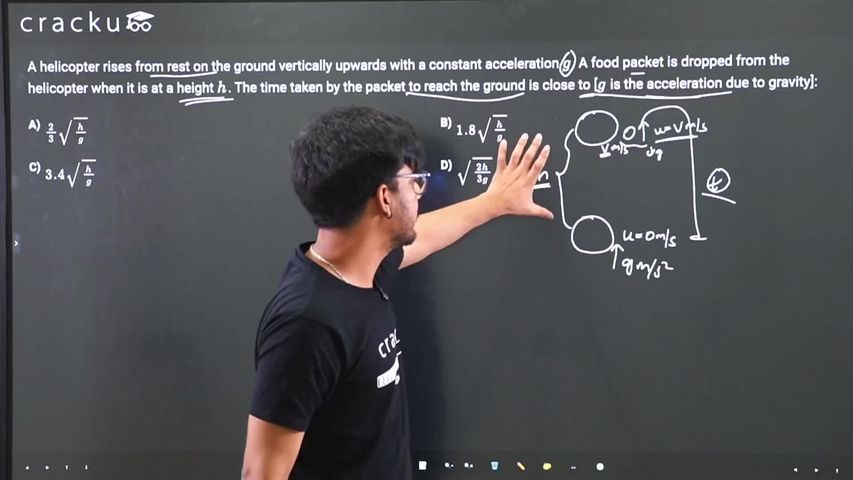
A helicopter rises from rest on the ground vertically upwards with a constant acceleration $$g$$. A food packet is dropped from the helicopter when it is at a height $$h$$. The time taken by the packet to reach the ground is close to [$$g$$ is the acceleration due to gravity]:
We begin with the upward motion of the helicopter itself. Starting from rest and moving with a constant upward acceleration $$g$$, the displacement $$s$$ reached in time $$t_1$$ is given by the kinematic equation
$$s = \tfrac12 a t^2.$$
Here $$a = g$$ (upward) and the helicopter has to climb a height $$h$$ before the food packet is released. Substituting these values we get
$$h \;=\; \tfrac12\,g\,t_1^{\,2}.$$
Solving for the time $$t_1$$ of ascent,
$$t_1 \;=\; \sqrt{\dfrac{2h}{g}}.$$
The upward velocity acquired by the helicopter at this instant is found from the relation $$v = u + at$$. Because the helicopter started from rest, $$u = 0$$, so
$$v \;=\; 0 + g\,t_1 \;=\; g\,\sqrt{\dfrac{2h}{g}} \;=\; \sqrt{2gh}.$$
This is also the initial velocity $$u$$ of the food packet at the moment it is dropped, and it is directed upward. The packet is now in free fall under gravity alone, so after release its acceleration is downward with magnitude $$g$$. Taking the upward direction as positive, we write the displacement equation for the packet:
$$y \;=\; h \;+\; u\,t \;-\; \tfrac12\,g\,t^2,$$
where $$y$$ is the height above the ground after an additional time $$t$$. The packet reaches the ground when $$y = 0$$, so we set
$$0 \;=\; h \;+\; \sqrt{2gh}\,t \;-\; \tfrac12\,g\,t^2.$$
Multiplying every term by 2 to clear the fraction,
$$0 \;=\; 2h \;+\; 2\sqrt{2gh}\,t \;-\; g\,t^2.$$
Re-arranging in the standard quadratic form $$a t^2 + b t + c = 0$$ gives
$$g\,t^{\,2} \;-\; 2\sqrt{2gh}\,t \;-\; 2h \;=\; 0.$$
Using the quadratic formula $$t = \dfrac{-b \pm \sqrt{b^2 - 4ac}}{2a}$$ with $$a = g,\; b = -2\sqrt{2gh},\; c = -2h,$$ we find
$$t \;=\; \dfrac{2\sqrt{2gh} \;+\; \sqrt{\left(2\sqrt{2gh}\right)^{\!2} + 4g(2h)}}{2g}.$$
Inside the square root,
$$(2\sqrt{2gh})^{\!2} = 8gh,\qquad 4g(2h) = 8gh,$$
so their sum is $$16gh$$ and its square root is $$4\sqrt{gh}$$. Substituting this back,
$$t \;=\; \dfrac{2\sqrt{2gh} \;+\; 4\sqrt{gh}}{2g}.$$
Factorizing $$\sqrt{gh}$$ from the numerator gives
$$t \;=\; \dfrac{\left(2\sqrt{2} \;+\; 4\right)\sqrt{gh}}{2g}.$$
Dividing numerator and denominator by 2,
$$t \;=\; \left(\sqrt{2} + 2\right)\sqrt{\dfrac{h}{g}}.$$
Numerically, $$\sqrt{2} \approx 1.414$$, so
$$t \;\approx\; (1.414 + 2)\,\sqrt{\dfrac{h}{g}} \;=\; 3.414\,\sqrt{\dfrac{h}{g}}.$$
This is very close to $$3.4\sqrt{\dfrac{h}{g}}$$, which corresponds to Option C.
Hence, the correct answer is Option C.
Was this solution helpful?
Click on the Email ☝️ to Watch the Video Solution
Create a FREE account and get:
_1.webp)

Educational materials for JEE preparation

Ask our AI anything

AI can make mistakes. Please verify important information.
AI can make mistakes. Please verify important information.


