
Join Our JEE Preparation Group
Prep with like-minded aspirants; Get access to free daily tests and study material.
Sign in
Please select an account to continue using cracku.in
↓ →
Join Our JEE Preparation Group
Prep with like-minded aspirants; Get access to free daily tests and study material.
Two liquids of densities $$\rho_1$$ and $$\rho_2$$ ($$\rho_2 = 2\rho_1$$) are filled up behind a square wall of side 10 m as shown in figure. Each liquid has a height of 5 m. The ratio of the forces due to these liquids exerted on upper part MN to that at the lower part NO is (Assume that the liquids are not mixing):
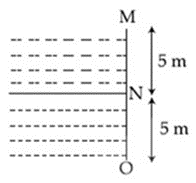
Let the width of the square wall be $$L = 10\text{ m}$$ and height of each layer be $$h = 5\text{ m}$$.
Average pressure on the upper part MN: $$P_{\text{avg1}} = \frac{0 + \rho_1 gh}{2} = \frac{1}{2}\rho_1 gh$$
Hydrostatic force on the upper part MN: $$F_{\text{MN}} = P_{\text{avg1}} \times (L \times h) = \frac{1}{2}\rho_1 gh^2 L$$
Pressure at depth $$h$$ (interface point N) and depth $$2h$$ (bottom point O): $$P_N = \rho_1 gh, \quad P_O = \rho_1 gh + \rho_2 gh$$
Average pressure on the lower part NO: $$P_{\text{avg2}} = \frac{P_N + P_O}{2} = \frac{\rho_1 gh + (\rho_1 gh + \rho_2 gh)}{2} = \rho_1 gh + \frac{1}{2}\rho_2 gh$$
$$P_{\text{avg2}} = \rho_1 gh + \frac{1}{2}(2\rho_1)gh = 2\rho_1 gh$$
Hydrostatic force on the lower part NO: $$F_{\text{NO}} = P_{\text{avg2}} \times (L \times h) = 2\rho_1 gh^2 L$$
$$\frac{F_{\text{MN}}}{F_{\text{NO}}} = \frac{\frac{1}{2}\rho_1 gh^2 L}{2\rho_1 gh^2 L} = \frac{1}{4}$$
Was this solution helpful?
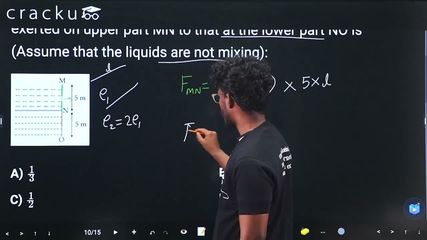
Click on the Email ☝️ to Watch the Video Solution
Create a FREE account and get:
_1.webp)

Educational materials for JEE preparation

Ask our AI anything

AI can make mistakes. Please verify important information.
AI can make mistakes. Please verify important information.
