
Join Our JEE Preparation Group
Prep with like-minded aspirants; Get access to free daily tests and study material.
Sign in
Please select an account to continue using cracku.in
↓ →
Join Our JEE Preparation Group
Prep with like-minded aspirants; Get access to free daily tests and study material.
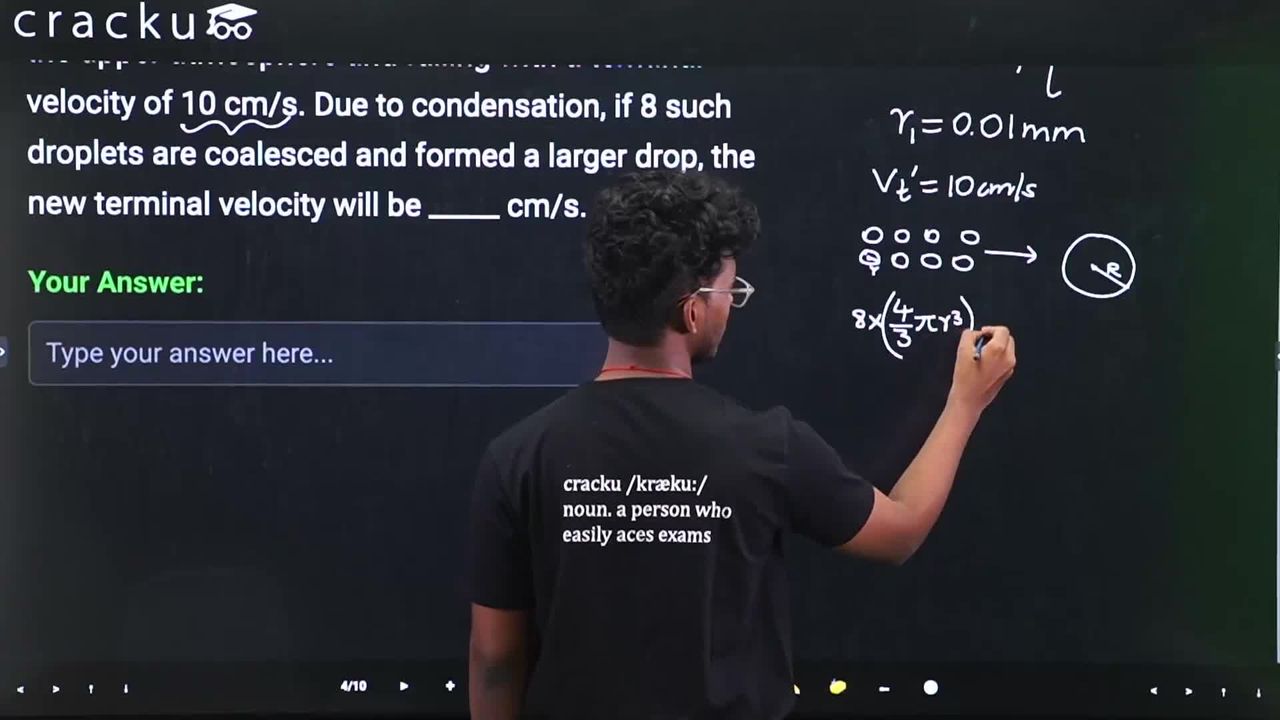
Small water droplets of radius 0.01 mm are formed in the upper atmosphere and falling with a terminal velocity of 10 cm/s. Due to condensation, if 8 such droplets are coalesced and formed a larger drop, the new terminal velocity will be _____ cm/s.
Correct Answer: 40
We are given that small water droplets with radius $$r = 0.01$$ mm fall with terminal velocity $$v_t = 10$$ cm/s. When eight such droplets coalesce to form a larger drop, we need to find the new terminal velocity.
Recall that for a small sphere falling through a viscous medium, Stokes’ law gives the terminal velocity as $$v_t = \frac{2r^2(\rho - \sigma)g}{9\eta}$$, where $$r$$ is the radius, $$\rho$$ is the density of the sphere, $$\sigma$$ is the density of the medium, $$g$$ is the acceleration due to gravity, and $$\eta$$ is the viscosity of the medium. From this expression, it follows that $$v_t \propto r^2$$.
When eight small droplets merge, volume conservation implies $$\frac{4}{3}\pi R^3 = 8 \times \frac{4}{3}\pi r^3$$, which simplifies to $$R^3 = 8r^3$$ and hence $$R = 2r$$. This shows that the radius of the larger drop is twice that of each small droplet.
Since the terminal velocity varies as the square of the radius, the ratio of the new terminal velocity to the original one is $$\frac{v'}{v_t} = \frac{R^2}{r^2} = \frac{(2r)^2}{r^2} = 4$$. From this it follows that $$v' = 4 \times v_t = 4 \times 10 = 40\text{ cm/s}$$.
The answer is 40 cm/s.
Was this solution helpful?
Click on the Email ☝️ to Watch the Video Solution
Create a FREE account and get:
_1.webp)

Educational materials for JEE preparation

Ask our AI anything

AI can make mistakes. Please verify important information.
AI can make mistakes. Please verify important information.
