
Join Our JEE Preparation Group
Prep with like-minded aspirants; Get access to free daily tests and study material.
Sign in
Please select an account to continue using cracku.in
↓ →
Join Our JEE Preparation Group
Prep with like-minded aspirants; Get access to free daily tests and study material.
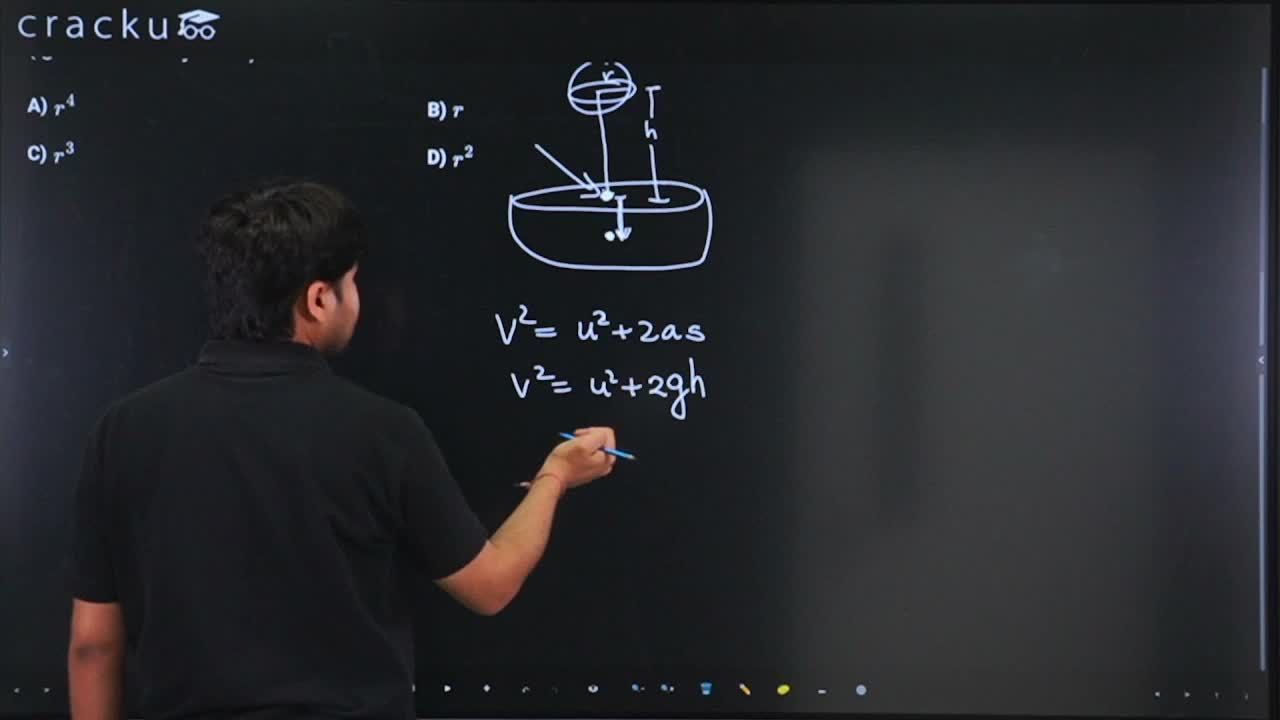
In an experiment to verify Stokes law, a small spherical ball of radius $$r$$ and density $$\rho$$ falls under gravity through a distance $$h$$ in air before entering a tank of water. If the terminal velocity of the ball inside water is same as its velocity just before entering the water surface, then the value of $$h$$ is proportional to: (ignore viscosity of air)
We begin by noting that the metal (or glass) sphere is first allowed to fall through air. We are told to neglect the viscosity of air, so the only significant force acting on the ball in air is its weight. Consequently the ball performs free-fall motion.
For a freely falling body that starts from rest and drops through a vertical distance $$h$$, the kinematic relation
$$v^2 \;=\; u^2 \;+\; 2\,g\,h$$
applies (where $$u=0$$ because the ball is released from rest). Hence the speed of the sphere just before it touches the water surface is
$$v_{\text{air}} \;=\; \sqrt{2\,g\,h}.$$
Once the sphere enters the water, its motion is governed by viscous drag. For slow motion of a small sphere in a viscous fluid the drag force is given by Stokes’ law, and the sphere quickly attains a constant (terminal) speed. Stokes’ law states explicitly that the terminal velocity $$v_t$$ of a sphere of radius $$r$$ descending in a fluid of viscosity $$\eta$$ is
$$v_t \;=\; \dfrac{2}{9}\,\dfrac{r^{2}\,g\,(\rho-\rho_w)}{\eta},$$
where
• $$\rho$$ is the density of the sphere,
• $$\rho_w$$ is the density of water,
• $$g$$ is the acceleration due to gravity.
The problem states that the terminal velocity attained inside water is numerically equal to the velocity that the sphere already possessed on just entering the water. Symbolically,
$$v_t \;=\; v_{\text{air}}.$$
Substituting the two expressions derived above, we have
$$\dfrac{2}{9}\,\dfrac{r^{2}\,g\,(\rho-\rho_w)}{\eta} \;=\; \sqrt{2\,g\,h}.$$
Our aim is to solve this equality for $$h$$ in terms of $$r$$ and note the resulting proportionality. First, square both sides to remove the square root:
$$\left(\dfrac{2}{9}\,\dfrac{r^{2}\,g\,(\rho-\rho_w)}{\eta}\right)^{2} \;=\; 2\,g\,h.$$
Now isolate $$h$$ by dividing both sides by $$2\,g$$:
$$h \;=\; \dfrac{1}{2\,g}\,\left(\dfrac{2}{9}\,\dfrac{r^{2}\,g\,(\rho-\rho_w)}{\eta}\right)^{2}.$$
We next expand the square in the numerator step by step:
$$h \;=\; \dfrac{1}{2\,g}\;\Bigg[\;\dfrac{4}{81}\;r^{4}\;g^{2}\;(\rho-\rho_w)^{2}\;\dfrac{1}{\eta^{2}}\;\Bigg].$$
Combining the constants outside, we obtain
$$h \;=\; \dfrac{4}{81}\,\dfrac{g^{2}}{2\,g}\;\dfrac{(\rho-\rho_w)^{2}}{\eta^{2}}\;r^{4}.$$
Simplifying $$g^{2}/(2\,g)=g/2$$ and $$4/(81)\times 1/2 = 2/81$$, we find
$$h \;=\; \dfrac{2}{81}\;\dfrac{g\,(\rho-\rho_w)^{2}}{\eta^{2}}\;r^{4}.$$
Every term enclosed in the large bracket is independent of the radius $$r$$, whereas $$r^{4}$$ appears as an explicit factor. Therefore
$$h \;\propto\; r^{4}.$$
Hence, the correct answer is Option A.
Was this solution helpful?
Click on the Email ☝️ to Watch the Video Solution
Create a FREE account and get:
_1.webp)

Educational materials for JEE preparation

Ask our AI anything

AI can make mistakes. Please verify important information.
AI can make mistakes. Please verify important information.
