
Join Our JEE Preparation Group
Prep with like-minded aspirants; Get access to free daily tests and study material.
Sign in
Please select an account to continue using cracku.in
↓ →
Join Our JEE Preparation Group
Prep with like-minded aspirants; Get access to free daily tests and study material.
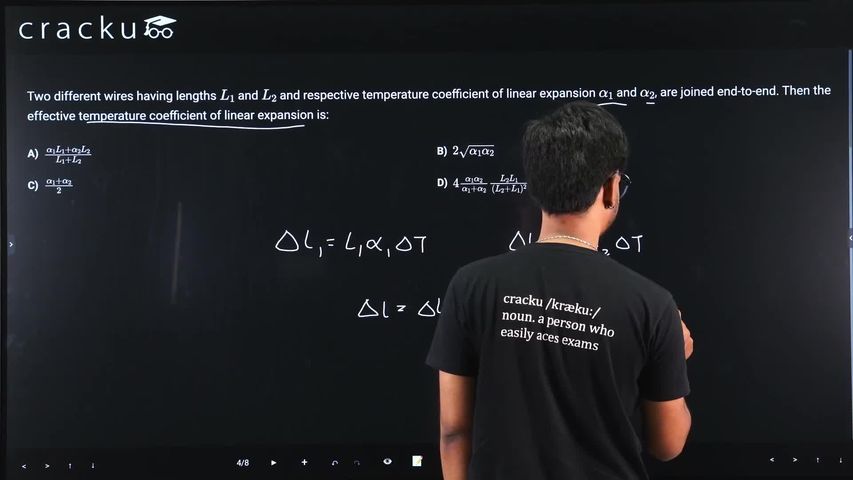
Two different wires having lengths $$L_1$$ and $$L_2$$ and respective temperature coefficient of linear expansion $$\alpha_1$$ and $$\alpha_2$$, are joined end-to-end. Then the effective temperature coefficient of linear expansion is:
Let us begin by recalling the definition of the temperature coefficient of linear expansion. If a rod of initial length $$L$$ is heated through a small temperature rise $$\Delta T$$, its increase in length $$\Delta L$$ is given by
$$\Delta L \;=\; \alpha\,L\,\Delta T,$$
where $$\alpha$$ is called the (linear) temperature coefficient of expansion for that material.
Now we have two different wires. Their individual data are
Length of first wire: $$L_1\,,\qquad$$ coefficient: $$\alpha_1$$,
Length of second wire: $$L_2\,,\qquad$$ coefficient: $$\alpha_2$$.
The two wires are joined end-to-end (in series), so the overall initial length of the composite wire is
$$L_{\text{total}} \;=\; L_1 + L_2.$$
Suppose the temperature of the whole system rises by the same small amount $$\Delta T$$. Each segment expands according to its own coefficient:
For the first wire we have
$$\Delta L_1 \;=\; \alpha_1\,L_1\,\Delta T.$$
For the second wire we have
$$\Delta L_2 \;=\; \alpha_2\,L_2\,\Delta T.$$
Because the segments are in series, their elongations simply add. Therefore the total elongation of the composite wire is
$$\Delta L_{\text{total}} \;=\; \Delta L_1 + \Delta L_2 \;=\; \alpha_1 L_1 \Delta T \;+\; \alpha_2 L_2 \Delta T.$$
Factorising out the common $$\Delta T$$ we obtain
$$\Delta L_{\text{total}} \;=\; \left( \alpha_1 L_1 + \alpha_2 L_2 \right)\Delta T.$$
Next, we define an effective (or equivalent) coefficient of linear expansion, say $$\alpha_{\text{eff}}$$, for the whole composite wire by using the same basic formula applied to the total length:
$$\Delta L_{\text{total}} \;=\; \alpha_{\text{eff}}\;L_{\text{total}}\;\Delta T \;=\; \alpha_{\text{eff}}\,(L_1 + L_2)\,\Delta T.$$
We now have two expressions for the same quantity $$\Delta L_{\text{total}}$$. Equating them gives
$$\alpha_{\text{eff}}\,(L_1 + L_2)\,\Delta T \;=\; \left( \alpha_1 L_1 + \alpha_2 L_2 \right)\Delta T.$$
Because $$\Delta T$$ is non-zero, it can be cancelled from both sides, leaving
$$\alpha_{\text{eff}}\,(L_1 + L_2) \;=\; \alpha_1 L_1 + \alpha_2 L_2.$$
Finally, solving for $$\alpha_{\text{eff}}$$ we divide by $$L_1 + L_2$$:
$$\alpha_{\text{eff}} \;=\; \frac{\alpha_1 L_1 + \alpha_2 L_2}{L_1 + L_2}.$$
This result matches Option A.
Hence, the correct answer is Option A.
Was this solution helpful?
Click on the Email ☝️ to Watch the Video Solution
Create a FREE account and get:
_1.webp)

Educational materials for JEE preparation

Ask our AI anything

AI can make mistakes. Please verify important information.
AI can make mistakes. Please verify important information.
