
Join Our JEE Preparation Group
Prep with like-minded aspirants; Get access to free daily tests and study material.
Sign in
Please select an account to continue using cracku.in
↓ →
Join Our JEE Preparation Group
Prep with like-minded aspirants; Get access to free daily tests and study material.
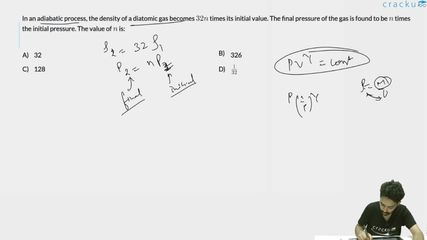
In an adiabatic process, the density of a diatomic gas becomes $$32n$$ times its initial value. The final pressure of the gas is found to be $$n$$ times the initial pressure. The value of $$n$$ is:
Let us denote the initial state of the di-atomic gas by the subscript 1 and the final state after the adiabatic change by the subscript 2.
So, the initial pressure and density are $$P_1$$ and $$\rho_1$$, while the final pressure and density are $$P_2$$ and $$\rho_2$$ respectively.
According to the statement of the problem, the density becomes $$32$$ times its initial value. Therefore
$$\rho_2 \;=\; 32\,\rho_1.$$
We are told that the final pressure is $$n$$ times the initial pressure. Hence
$$P_2 \;=\; n\,P_1.$$
Because the change is adiabatic, we must use the adiabatic relation that connects pressure and volume. First we recall the formula
$$P\,V^{\gamma} \;=\; \text{constant}$$
where $$\gamma$$ is the ratio of specific heats $$C_P/C_V$$. For a di-atomic ideal gas (with no vibrational modes excited in the temperature range considered) we have
$$\gamma \;=\;\frac{7}{5}.$$
To involve the density, we note that density is inversely proportional to volume for a fixed mass of gas. In symbols, if $$m$$ is the mass,
$$\rho \;=\;\frac{m}{V}\quad\Longrightarrow\quad V \;=\;\frac{m}{\rho} \;\propto\; \frac{1}{\rho}.$$
Substituting $$V = \dfrac{1}{\rho}$$ (ignoring the constant mass factor which cancels out when we form ratios) into the adiabatic relation, we obtain
$$P\Bigl(\frac{1}{\rho}\Bigr)^{\gamma} \;=\; \text{constant}.$$
Multiplying both sides by $$\rho^{\gamma}$$ gives
$$P \;\rho^{-\gamma}\;=\;\text{constant}\quad\Longrightarrow\quad P\;\rho^{-\gamma} = \text{constant}.$$ Therefore pressure and density are connected by
$$P \;\propto\; \rho^{\gamma}.$$
Using this proportionality for the two states, we write
$$\frac{P_2}{P_1} \;=\;\Bigl(\frac{\rho_2}{\rho_1}\Bigr)^{\gamma}.$$
Now we substitute the given multiples:
$$\frac{P_2}{P_1} \;=\; n,$$
and
$$\frac{\rho_2}{\rho_1} \;=\; 32.$$
Hence
$$n \;=\; 32^{\gamma}.$$
Putting $$\gamma = \dfrac{7}{5}$$, we have
$$n \;=\; 32^{\,\tfrac{7}{5}}.$$
We rewrite 32 as a power of 2 for convenience:
$$32 \;=\; 2^{5}.$$
Therefore
$$n \;=\; (2^{5})^{\tfrac{7}{5}}.$$
Using the law of exponents $$(a^{b})^{c} = a^{\,bc},$$ we obtain
$$n \;=\; 2^{\,5 \times \tfrac{7}{5}} \;=\; 2^{7}.$$
Now $$2^{7} = 128.$$
So we have found
$$n \;=\; 128.$$
Hence, the correct answer is Option 3.
Was this solution helpful?
Click on the Email ☝️ to Watch the Video Solution
Create a FREE account and get:
_1.webp)

Educational materials for JEE preparation

Ask our AI anything

AI can make mistakes. Please verify important information.
AI can make mistakes. Please verify important information.
