
Join Our JEE Preparation Group
Prep with like-minded aspirants; Get access to free daily tests and study material.
Sign in
Please select an account to continue using cracku.in
↓ →
Join Our JEE Preparation Group
Prep with like-minded aspirants; Get access to free daily tests and study material.
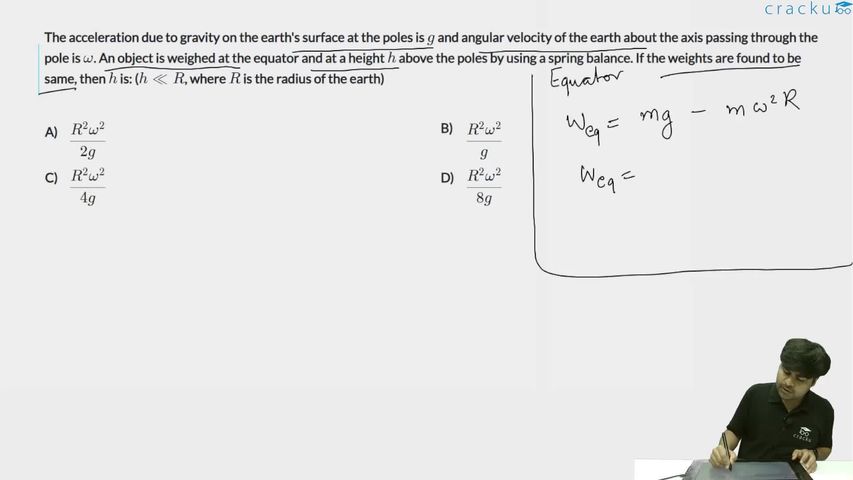
The acceleration due to gravity on the earth's surface at the poles is $$g$$ and angular velocity of the earth about the axis passing through the pole is $$\omega$$. An object is weighed at the equator and at a height $$h$$ above the poles by using a spring balance. If the weights are found to be same, then $$h$$ is: ($$h \ll R$$, where $$R$$ is the radius of the earth)
Let the mass of the object be $$m$$. Whenever a spring balance is used, it actually registers the normal reaction on the object, which we call the apparent weight.
First we consider the object kept on the equator at the earth’s surface. At the equator the object is moving in a horizontal circle of radius $$R$$ with the earth, so it experiences a centrifugal acceleration directed radially outward. The magnitude of this acceleration is $$\omega^{2}R$$, where $$\omega$$ is the earth’s angular velocity.
Hence the effective or apparent acceleration acting downward on the object at the equator is the vector difference of the true gravitational acceleration $$g$$ and the centrifugal acceleration $$\omega^{2}R$$. Therefore the apparent weight at the equator is
$$W_{e}=m\left(g-\omega^{2}R\right).$$
Now we take the same object to a point directly above the pole at a small height $$h$$ (with $$h\ll R$$). Exactly at the pole the distance of the object from the earth’s axis is zero, so it has no circular motion about the axis and hence no centrifugal effect. The only change comes from the fact that we are now at a larger distance $$R+h$$ from the earth’s centre.
The law of gravitation gives the gravitational acceleration at distance $$r$$ as $$g(r)=\dfrac{GM}{r^{2}}$$, where $$G$$ is the gravitational constant and $$M$$ is the earth’s mass. Putting $$r=R+h$$ we get
$$g_{p}=g\left(\dfrac{R}{R+h}\right)^{2}.$$
Because $$h\ll R$$ we expand by the binomial theorem. For any small $$x$$, $$(1+x)^{-2}\approx1-2x$$. Taking $$x=\dfrac{h}{R}$$ we have
$$\left(1+\dfrac{h}{R}\right)^{-2}\approx1-\dfrac{2h}{R}.$$
So
$$g_{p}\approx g\left(1-\dfrac{2h}{R}\right).$$
Thus the apparent weight at the height $$h$$ above the pole is simply
$$W_{p}=m\,g_{p}=m\,g\left(1-\dfrac{2h}{R}\right).$$
The problem states that the two spring-balance readings are the same, i.e.
$$W_{e}=W_{p}.$$
Substituting the expressions we have obtained:
$$m\left(g-\omega^{2}R\right)=m\,g\left(1-\dfrac{2h}{R}\right).$$
We cancel the common factor $$m$$ on both sides, giving
$$g-\omega^{2}R=g\left(1-\dfrac{2h}{R}\right).$$
Expanding the right-hand side:
$$g-\omega^{2}R=g-\dfrac{2gh}{R}.$$
Now we subtract $$g$$ from both sides to isolate the terms that contain $$h$$:
$$-\omega^{2}R=-\dfrac{2gh}{R}.$$
Multiplying by $$-1$$ removes the minus signs:
$$\omega^{2}R=\dfrac{2gh}{R}.$$
Finally we solve for $$h$$ by multiplying both sides by $$\dfrac{R}{2g}$$:
$$h=\dfrac{\omega^{2}R^{2}}{2g}.$$
This matches Option A.
Hence, the correct answer is Option A.
Was this solution helpful?
Click on the Email ☝️ to Watch the Video Solution
Create a FREE account and get:
_1.webp)

Educational materials for JEE preparation

Ask our AI anything

AI can make mistakes. Please verify important information.
AI can make mistakes. Please verify important information.
