
Join Our JEE Preparation Group
Prep with like-minded aspirants; Get access to free daily tests and study material.
Sign in
Please select an account to continue using cracku.in
↓ →
Join Our JEE Preparation Group
Prep with like-minded aspirants; Get access to free daily tests and study material.
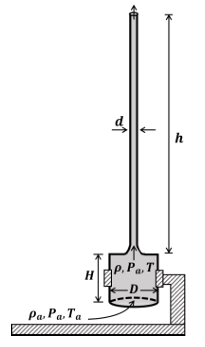
A cylindrical furnace has height (H) and diameter (D) both 1 m. It is maintained at temperature 360 K. The air gets heated inside the furnace at constant pressure $$P_a$$ and its temperature becomes $$T = 360$$ K. The hot air with density $$\rho$$ rises up a vertical chimney of diameter $$d = 0.1$$ m and height $$h = 9$$ m above the furnace and exits the chimney. As a result, atmospheric air of density $$\rho_a = 1.2$$ kg m$$^{-3}$$, pressure $$P_a$$ and temperature $$T_a = 300$$ K enters the furnace. Assume air as an ideal gas, neglect the variations in $$\rho$$ and $$T$$ inside the chimney and the furnace. Also ignore the viscous effects.
[Given: The acceleration due to gravity $$g = 10$$ ms$$^{-2}$$ and $$\pi = 3.14$$]
When the chimney is closed using a cap at the top, a pressure difference $$\Delta P$$ develops between the top and the bottom surfaces of the cap. If the changes in the temperature and density of the hot air, due to the stoppage of air flow, are negligible then the value of $$\Delta P$$ is ____ Nm$$^{-2}$$.
Correct Answer: 30
Inside the furnace the air is heated at the constant (atmospheric) pressure $$P_a$$ from $$T_a = 300\;{\rm K}$$ to $$T = 360\;{\rm K}$$.
For an ideal gas, $$\rho \,T = \rho_a \,T_a$$ at the same pressure, therefore the density of the hot air is
$$\rho = \rho_a\;\dfrac{T_a}{T}=1.2\;\dfrac{300}{360}=1.0\;{\rm kg\,m^{-3}}$$
With the chimney open, the upward motion of the hot air is produced by the difference between the weights of the two vertical columns of air (cold outside, hot inside) of the same height $$(H+h)=1+9=10\;{\rm m}$$. The driving pressure head is
$$\Delta P_{\text{drive}}=(\rho_a-\rho)\,g\,(H+h) =(1.2-1.0)\times10\times10 =20\;{\rm N\,m^{-2}}$$
Neglecting viscous losses, Bernoulli’s theorem for the stream‐line from the furnace inlet (very large area, negligible speed) to the chimney exit gives
$$\frac{1}{2}\,\rho\,v^{2}= \Delta P_{\text{drive}} \quad\Longrightarrow\quad v=\sqrt{\dfrac{2\,\Delta P_{\text{drive}}}{\rho}} =\sqrt{\dfrac{2\times20}{1.0}} =6\;{\rm m\,s^{-1}}$$
This velocity corresponds to a dynamic pressure (stagnation over static) of
$$\Delta P_{\text{dyn}}=\dfrac{1}{2}\,\rho\,v^{2}=20\;{\rm N\,m^{-2}}$$
Now a cap is fixed at the top of the chimney. The rising air jet strikes the lower face of the cap and comes to rest there; its dynamic pressure therefore appears as an additional static pressure on the underside of the cap. Besides this, the column of hot air inside the furnace of height $$H=1\;{\rm m}$$ still exerts its usual hydrostatic pressure difference
$$\Delta P_{\text{hyd}}=\rho\,g\,H =1.0\times10\times1 =10\;{\rm N\,m^{-2}}$$
Hence the net pressure difference between the top (outer) and the bottom (inner) faces of the cap after it is closed is
$$\Delta P =\Delta P_{\text{dyn}}+\Delta P_{\text{hyd}} =20+10 =30\;{\rm N\,m^{-2}}$$
Therefore, the required pressure difference is
30 N m−2.
Was this solution helpful?
Create a FREE account and get:
_1.webp)

Educational materials for JEE preparation

Ask our AI anything

AI can make mistakes. Please verify important information.
AI can make mistakes. Please verify important information.
