
Join Our JEE Preparation Group
Prep with like-minded aspirants; Get access to free daily tests and study material.
Sign in
Please select an account to continue using cracku.in
↓ →
Join Our JEE Preparation Group
Prep with like-minded aspirants; Get access to free daily tests and study material.
The energy of a system is given as $$E(t)=\alpha^{3}e^{-\beta t}$$, where t is the time and $$\beta= 0.3s^{-1}$$. The errors in the measurement of $$\alpha$$ and t are 1.2% and 1.6%, respectively. At t=5s,maximum percentage error in the energy is:
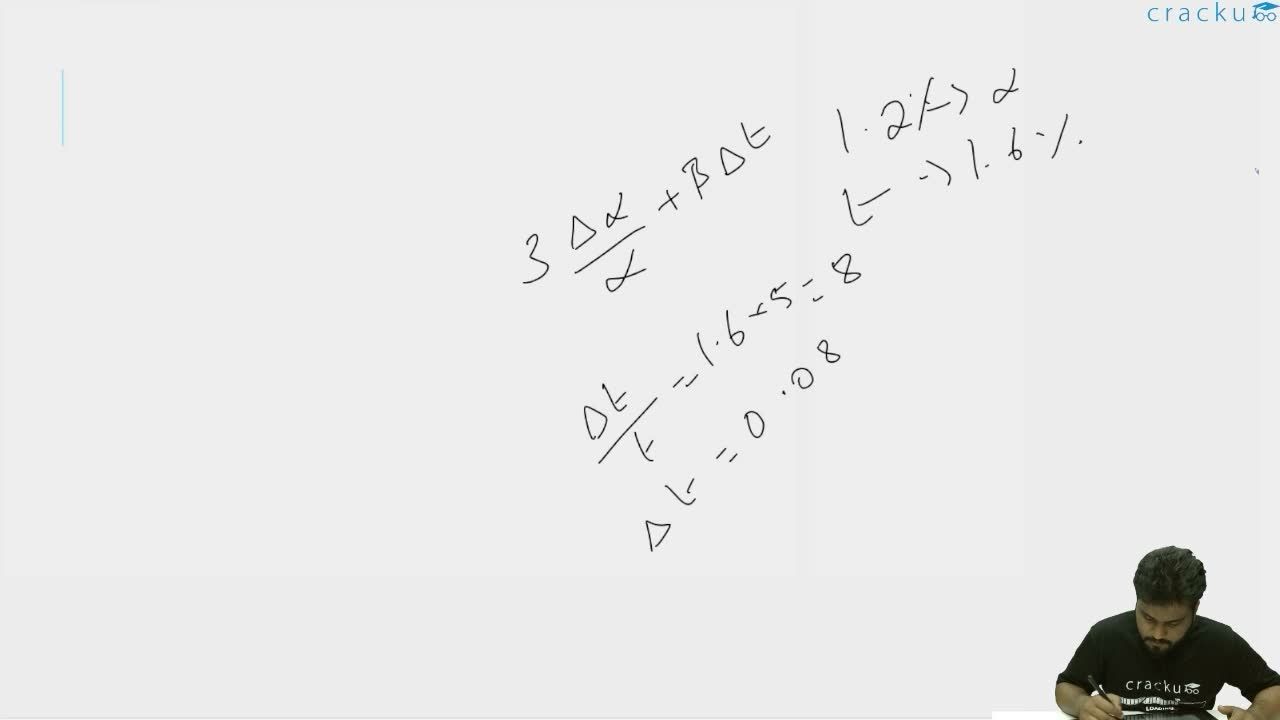
Given $$E(t) = \alpha^3 e^{-\beta t}$$ with $$\beta = 0.3$$ s⁻¹ and relative errors $$\Delta\alpha/\alpha = 1.2\%$$, $$\Delta t/t = 1.6\%$$, we want to find the maximum percentage error in $$E$$ at $$t = 5\,$$s}.
We begin by taking the natural logarithm of $$E$$ to prepare for error propagation:
$$\ln E = 3\ln\alpha - \beta t$$
By differentiating this relation, the relative error in $$E$$ becomes
$$\frac{\Delta E}{E} = 3\frac{\Delta\alpha}{\alpha} + \beta \Delta t$$
Since $$\Delta t/t = 1.6\%$$ at $$t = 5\,$$s}, we calculate
$$\Delta t = 0.016 \times 5 = 0.08\ \text{s}$$
Substituting $$\Delta\alpha/\alpha = 1.2\%$$ and the computed $$\Delta t$$ into the expression for $$\Delta E/E$$ and converting to a percentage gives
$$\frac{\Delta E}{E} \times 100 = 3 \times 1.2\% + \beta \times \Delta t \times 100$$
$$= 3.6\% + 0.3 \times 0.08 \times 100$$
$$= 3.6\% + 2.4\%$$
$$= 6\%$$
Therefore, the maximum percentage error in $$E$$ at $$t=5\,$$s} is 6\%, which corresponds to Option 1.
Was this solution helpful?
Click on the Email ☝️ to Watch the Video Solution
Create a FREE account and get:
_1.webp)

Educational materials for JEE preparation

Ask our AI anything

AI can make mistakes. Please verify important information.
AI can make mistakes. Please verify important information.
