
Join Our JEE Preparation Group
Prep with like-minded aspirants; Get access to free daily tests and study material.
Sign in
Please select an account to continue using cracku.in
↓ →
Join Our JEE Preparation Group
Prep with like-minded aspirants; Get access to free daily tests and study material.
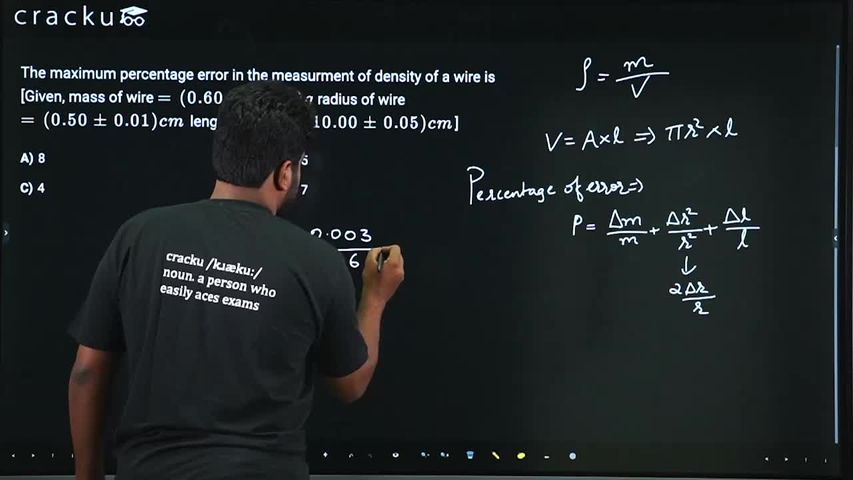
The maximum percentage error in the measurment of density of a wire is [Given, mass of wire $$=(0.60 \pm 0.003)g$$ radius of wire $$=(0.50 \pm 0.01)cm$$ length of wire $$=(10.00 \pm 0.05)cm$$]
Density of the wire is given by $$\rho = \frac{m}{V}$$ where the volume of a cylindrical wire is $$V = \pi r^{2} \, l$$.
Therefore $$\rho = \frac{m}{\pi r^{2} l}$$.
For a function of several variables, the maximum fractional (relative) error is obtained by adding the absolute fractional errors of all factors:
$$\frac{\Delta \rho}{\rho} = \frac{\Delta m}{m} + \frac{\Delta (r^{2})}{r^{2}} + \frac{\Delta l}{l}$$.
Step 1: Fractional error in mass
Given $$m = 0.60 \text{ g} \pm 0.003 \text{ g}$$.
$$\frac{\Delta m}{m} = \frac{0.003}{0.60} = 0.005 = 0.5\%$$.
Step 2: Fractional error in radius
Given $$r = 0.50 \text{ cm} \pm 0.01 \text{ cm}$$.
$$\frac{\Delta r}{r} = \frac{0.01}{0.50} = 0.02 = 2\%$$.
Step 3: Fractional error in $$r^{2}$$
Since $$r^{2}$$ contains the radius twice, its fractional error is twice that of $$r$$:
$$\frac{\Delta (r^{2})}{r^{2}} = 2 \times \frac{\Delta r}{r} = 2 \times 2\% = 4\%$$.
Step 4: Fractional error in length
Given $$l = 10.00 \text{ cm} \pm 0.05 \text{ cm}$$.
$$\frac{\Delta l}{l} = \frac{0.05}{10.00} = 0.005 = 0.5\%$$.
Step 5: Total fractional (percentage) error in density
$$\frac{\Delta \rho}{\rho} = 0.5\% + 4\% + 0.5\% = 5\%$$.
Hence the maximum percentage error in the measurement of density is $$5\%$$.
Therefore, the correct option is Option B (5).
Was this solution helpful?
Click on the Email ☝️ to Watch the Video Solution
Create a FREE account and get:
_1.webp)

Educational materials for JEE preparation

Ask our AI anything

AI can make mistakes. Please verify important information.
AI can make mistakes. Please verify important information.
