
Join Our JEE Preparation Group
Prep with like-minded aspirants; Get access to free daily tests and study material.
Sign in
Please select an account to continue using cracku.in
↓ →
Join Our JEE Preparation Group
Prep with like-minded aspirants; Get access to free daily tests and study material.
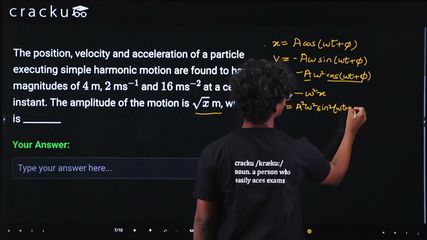
The position, velocity and acceleration of a particle executing simple harmonic motion are found to have magnitudes of $$4$$ m, $$2$$ ms$$^{-1}$$ and $$16$$ ms$$^{-2}$$ at a certain instant. The amplitude of the motion is $$\sqrt{x}$$ m, where $$x$$ is ________
Correct Answer: 17
We are given the magnitudes of position, velocity, and acceleration of a particle in SHM at a certain instant: $$|x| = 4$$ m, $$|v| = 2$$ m/s, $$|a| = 16$$ m/s$$^2$$. We need to find the amplitude $$A = \sqrt{x}$$ and determine $$x$$.
We recall the fundamental relations in SHM.
For a particle executing SHM:
- Displacement: $$x = A\sin(\omega t + \phi)$$
- Velocity: $$v = A\omega\cos(\omega t + \phi)$$
- Acceleration: $$a = -\omega^2 x$$
- Velocity-displacement relation: $$v^2 = \omega^2(A^2 - x^2)$$
Next, we find the angular frequency $$\omega$$.
From the acceleration-displacement relation $$|a| = \omega^2 |x|$$:
$$ \omega^2 = \frac{|a|}{|x|} = \frac{16}{4} = 4 \text{ rad}^2/\text{s}^2 $$
Therefore, $$\omega = 2$$ rad/s.
We then find the amplitude using the velocity-displacement relation.
The relation $$v^2 = \omega^2(A^2 - x^2)$$ connects velocity, angular frequency, amplitude, and displacement. Substituting the known values:
$$ (2)^2 = 4(A^2 - (4)^2) $$
$$ 4 = 4(A^2 - 16) $$
Dividing both sides by 4:
$$ 1 = A^2 - 16 $$
$$ A^2 = 16 + 1 = 17 $$
$$ A = \sqrt{17} \text{ m} $$
Finally, we identify the value of $$x$$.
Since the amplitude is given as $$\sqrt{x}$$ m and we found $$A = \sqrt{17}$$ m:
$$ \sqrt{x} = \sqrt{17} $$
$$ x = 17 $$
The answer is $$\boxed{17}$$.
Was this solution helpful?
Click on the Email ☝️ to Watch the Video Solution
Create a FREE account and get:
_1.webp)

Educational materials for JEE preparation

Ask our AI anything

AI can make mistakes. Please verify important information.
AI can make mistakes. Please verify important information.
