
Join Our JEE Preparation Group
Prep with like-minded aspirants; Get access to free daily tests and study material.
Sign in
Please select an account to continue using cracku.in
↓ →
Join Our JEE Preparation Group
Prep with like-minded aspirants; Get access to free daily tests and study material.
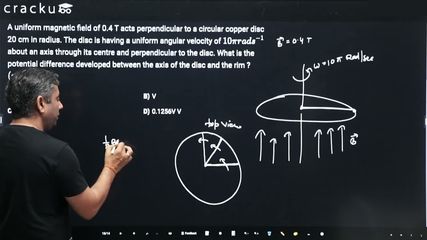
A uniform magnetic field of 0.4 T acts perpendicular to a circular copper disc 20 cm in radius. The disc is having a uniform angular velocity of $$10\pi rads^{-1}$$ about an axis through its centre and perpendicular to the disc. What is the potential difference developed between the axis of the disc and the rim ? $$(\pi = 3.14)$$
We start by noting that when a conducting disc rotates in a magnetic field perpendicular to its plane, the free electrons experience a force due to their velocity from rotation; this generates an emf between the center and the rim (Faraday disc/homopolar generator).
Next, consider a small radial element at distance $$r$$ from the center with width $$dr$$; its tangential velocity is $$v = \omega r$$, and the motional emf across this element is $$dE = Bv\,dr = B\omega r\,dr$$. To find the total emf between the center ($$r=0$$) and the rim ($$r=R$$), we integrate:
$$ E = \int_0^R B\omega r\,dr = B\omega \left[\frac{r^2}{2}\right]_0^R = \frac{1}{2}B\omega R^2 $$
Substituting the given values $$B = 0.4$$ T, $$\omega = 10\pi$$ rad/s, and $$R = 20$$ cm = 0.2 m into $$ E = \frac{1}{2}B\omega R^2 $$ yields
$$ E = \frac{1}{2} \times 0.4 \times 10\pi \times (0.2)^2 $$
$$ = \frac{1}{2} \times 0.4 \times 10\pi \times 0.04 $$
$$ = \frac{1}{2} \times 0.4 \times 0.4\pi $$
$$ = \frac{1}{2} \times 0.16\pi $$
$$ = 0.08\pi $$
$$ = 0.08 \times 3.14 = 0.2512 \text{ V} $$
Therefore, the potential difference between the axis and the rim is 0.2512 V, corresponding to Option C.
Was this solution helpful?
Click on the Email ☝️ to Watch the Video Solution
Create a FREE account and get:
_1.webp)

Educational materials for JEE preparation

Ask our AI anything

AI can make mistakes. Please verify important information.
AI can make mistakes. Please verify important information.
