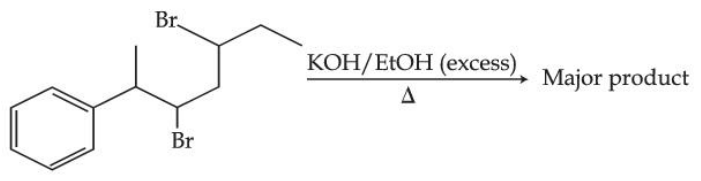
For the following questions answer them individually
Let $$A = \begin{bmatrix}\frac{1}{\sqrt{2}} & -2 \\0 & 1 \end{bmatrix}$$ and $$P = \begin{bmatrix}\cos \theta & -\sin \theta \\\sin \theta & \cos \theta \end{bmatrix}$$ ,$$\theta > 0$$. If $$B = PAP^{T}, C = P^{T}B^{10}P$$ and the sum of the diagonal elements of $$C$$ is $$\frac{m}{n}$$, where $$gcd(m,n)=1,$$ m + n is :
If the components of $$\overrightarrow{a} = \alpha \hat{i}+\beta \hat{j}+\gamma \hat{k}$$ along and perpendicular to $$\overrightarrow{b}= 3\hat{i}+\hat{j}-\hat{k}$$ respectively, are $$frac{16}{11}(3\hat{i}+\hat{j}-\hat{k})$$ and $$frac{1}{11}(-4\hat{i}-5\hat{j}-17\hat{k})$$, then $$\alpha^{2} + \beta^{2} + \gamma^{2}$$ is equals to :
Let A, B, C be three points in $$xy-plane$$, whose position vector are given by $$\sqrt{3}\hat{i}+\hat{j}, \hat{i}+\sqrt{3}\hat{j}$$ and $$a\hat{i}+ (1-a)\hat{j}$$ respectively with respect to the origin O . If the distance of the point C from the line bisecting the angle between the vectors $$\overrightarrow{OA}$$ and $$\overrightarrow{OB}$$ is $$\frac{9}{\sqrt{2}}$$, then the sum of all the possible values of $$a$$ is :
Let the coefficients of three consecutive terms $$T_{r},T_{r+1}$$ and $$T_{r+2}$$ in the binomial expansion of $$(a+b)^{12}$$ be in a G.P. and let $$p$$ be the number of all possible values of $$r$$. Let $$q$$ be the sum of all rational terms in the binomial expansion of $$(\sqrt[4]{3}+\sqrt[3]{4})^{12}$$ Then p + q is equals to :
Let $$[x]$$ denote the greatest integer less than or equal to $$x$$. Then the domain of $$f(x)=sec^{-1}(2[x]+1)$$ is:
Let S be the set of all the words that can be formed by arranging all the letters of the word GARDEN. From the set S, one word is selected at random. The probability that the selected word will NOT have vowels in alphabetical order is :
If $$\sum_{r=1}^{13}\left\{\frac{1}{\sin(\frac{\pi}{4}+(r-1)\frac{\pi}{6})\sin(\frac{\pi}{4}+\frac{r\pi}{6})}\right\}=a\sqrt{3}+b,a,b \in Z$$ then $$a^{2}+b^{2}$$ is equal to:
Let $$f$$ be a real valued continuous function defined on the positive real axis such that $$g(x)=\int_{0}^{x}t f(t)dt$$. If $$g(x^{3})=x^{6}+x^{7}$$, then Value of $$\sum_{r=1}^{15}f(r^{3})$$ is:
Let $$f : [0:3]\rightarrow A$$ be difined by $$f(x)=2x^{3}-15x^{2}+36x+7$$ and $$g: [0,\infty)\rightarrow B$$ be difined by $$g(x)=\frac{x^{2015}}{x^{2025}+1}$$. If both the functions are onto and $$S=\left\{x \in Z : x \in A or x \in B \right\}$$, then n(S) is equal to:
Bag $$B_{1}$$ contains 6 white and 4 blue balls, Bag $$B_{2}$$ contains 4 white and 6 blue balls, and Bag $$B_{3}$$ contains 5 white and 5 blue balls. One of the bags is selected at random and a ball is drawn from it. If the ball is white, then the probability, that the ball is drawn from Bag $$B_{2}$$, is :