NTA JEE Mains 28th Jan 2025 Shift 2
For the following questions answer them individually
NTA JEE Mains 28th Jan 2025 Shift 2 - Question 61
Which of the following is/are not correct with respect to energy of atomic orbitals of hydrogen atom? (A)1s < 2p < 3d < 4s (B) 1s < 2s = 2p < 3s = 3p (C)1s < 2s < 2p < 3s < 3p (D) 1s < 2s < 4s < 3d
Choose the correct answer from the options given below :
NTA JEE Mains 28th Jan 2025 Shift 2 - Question 62
Consider an elementary reaction $$A(g)+B(g)\rightarrow C(g)+D(g)$$ If the volume of reaction mixture is suddenly reduced to $$\frac{1}{3}$$ of its initial volume, the reaction rate will become 'x' times of the original reaction rate. The value of x is :
NTA JEE Mains 28th Jan 2025 Shift 2 - Question 63
The product formed in the following reaction sequence is :


NTA JEE Mains 28th Jan 2025 Shift 2 - Question 64
Assume a living cell with $$0.9%(\omega / \omega)$$ of glucose solution (aqueous). This cell is immersed in another solution having equal mole fraction of glucose and water. (Consider the data upto first decimal place only) The cell will
NTA JEE Mains 28th Jan 2025 Shift 2 - Question 65
Given below are two statements : Statement (I): According to the Law of Octaves, the elements were arranged in the increasing order of their atomic number. Statement (II): Meyer observed a periodically repeated pattern upon plotting physical properties of certain elements against their respective atomic numbers. In the light of the above statements, choose the correct answer from the options given below :
NTA JEE Mains 28th Jan 2025 Shift 2 - Question 66
Match List - I with List - II.
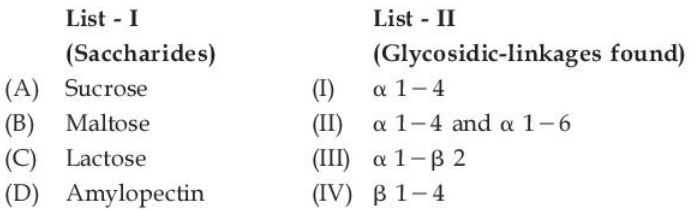
Choose the correct answer from the options given below :
NTA JEE Mains 28th Jan 2025 Shift 2 - Question 67
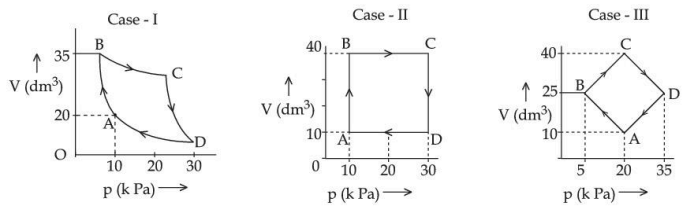
An ideal gas undergoes a cyclic transformation starting from the point A and coming back to the same point by tracing the path $$ A \rightarrow B \rightarrow C \rightarrow D \rightarrow A$$ as shown in the three cases above. Choose the correct option regarding $$\Delta U$$ :
NTA JEE Mains 28th Jan 2025 Shift 2 - Question 68
Identify the inorganic sulphides that are yellow in colour : (A) $$\mathrm{(NH_4)_2S}$$ (B) $$\mathrm{PbS}$$ (C) $$\mathrm{CuS}$$ (D) $$\mathrm{As_2S_3}$$ (E) $$\mathrm{As_2S_5}$$ Choose the correct answer from the options given below :
NTA JEE Mains 28th Jan 2025 Shift 2 - Question 69
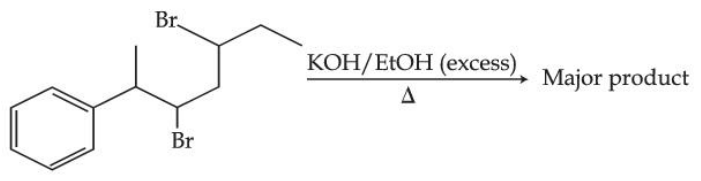
The major product of the following reaction is :
NTA JEE Mains 28th Jan 2025 Shift 2 - Question 70
Identify correct conversion during acidic hydrolysis from the following : (A) starch gives galactose. (B) cane sugar gives equal amount of glucose and fructose. (C) milk sugar gives glucose and galactose. (D) amylopectin gives glucose and fructose. (E) amylose gives only glucose. Choose the correct answer from the options given below :