
Join Our JEE Preparation Group
Prep with like-minded aspirants; Get access to free daily tests and study material.
Sign in
Please select an account to continue using cracku.in
↓ →
Join Our JEE Preparation Group
Prep with like-minded aspirants; Get access to free daily tests and study material.
If A and B are the points of intersection of the circle $$x^{2}+y^{2}-8x=0$$ and the hyperbola $$\frac{x^{2}}{9}-\frac{y^{2}}{4}=1$$ and a point P moves on the line $$2x-3y+4=0$$, then the centroid of $$ \triangle PAB $$ lies on the line:
The circle is $$x^{2}+y^{2}-8x=0$$, which can be written as $$(x-4)^{2}+y^{2}=16$$. Its centre is $$(4,0)$$ and radius is $$4$$.
The hyperbola is $$\frac{x^{2}}{9}-\frac{y^{2}}{4}=1$$, or equivalently $$4x^{2}-9y^{2}=36$$ $$-(1)$$.
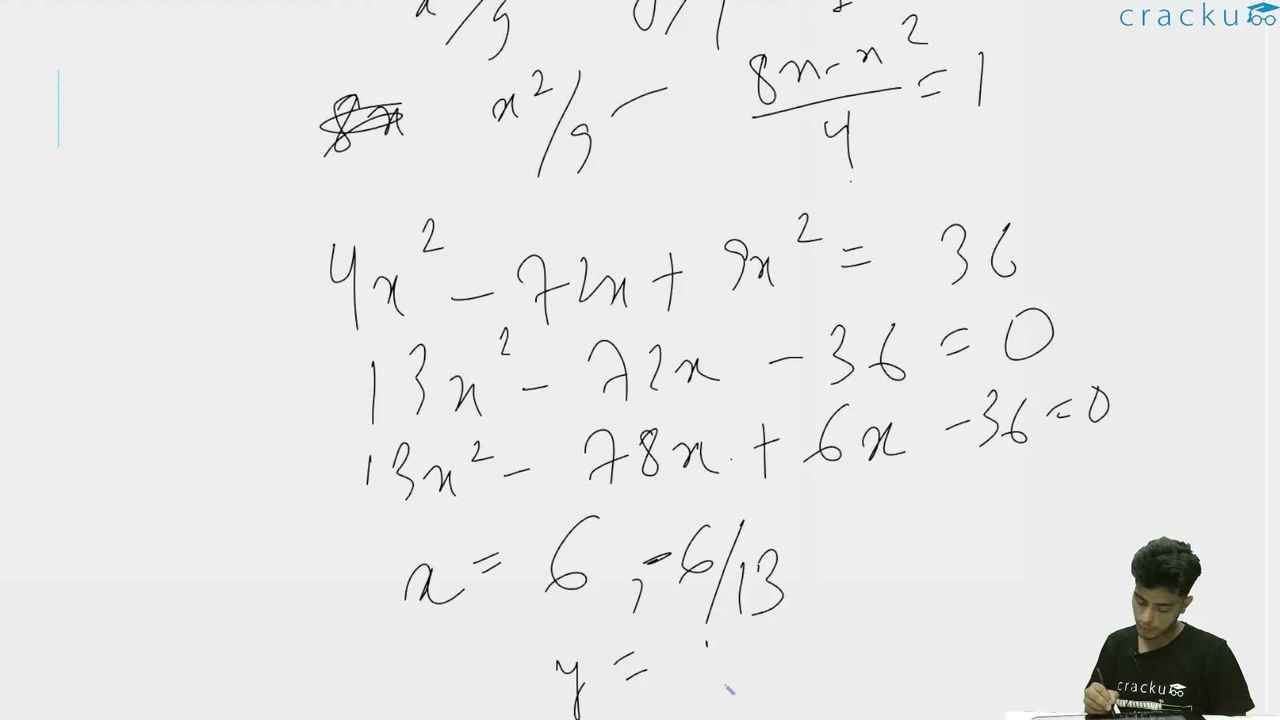
For the points of intersection A and B we must satisfy both the circle and the hyperbola. From the circle, $$y^{2}=8x-x^{2}$$ $$-(2)$$. Substituting $$y^{2}$$ from $$(2)$$ into $$(1)$$ gives
$$4x^{2}-9(8x-x^{2})=36$$ $$\Rightarrow 4x^{2}-72x+9x^{2}=36$$ $$\Rightarrow 13x^{2}-72x-36=0$$ $$-(3)$$.
The discriminant of $$(3)$$ is $$\Delta = (-72)^{2}-4\cdot 13\cdot (-36)=5184+1872=7056=84^{2}$$, so the roots are
$$x=\frac{72\pm 84}{26} \;\Rightarrow\; x_{1}=6,\; x_{2}=-\frac{6}{13}$$.
Using $$(2)$$ for each root: For $$x=6$$, $$y^{2}=8\cdot 6-6^{2}=48-36=12 \;\Rightarrow\; y=\pm 2\sqrt{3}$$. For $$x=-\dfrac{6}{13}$$, $$y^{2}=-\dfrac{660}{169}\lt 0$$, which is impossible. Hence the real intersection points are $$A(6,2\sqrt{3}),\; B(6,-2\sqrt{3})$$.
Let the moving point be $$P(x,y)$$ on the line $$2x-3y+4=0$$ $$-(4)$$.
The centroid $$G(X,Y)$$ of $$\triangle PAB$$ is $$X=\frac{x+6+6}{3}=\frac{x+12}{3}, \qquad Y=\frac{y+2\sqrt{3}-2\sqrt{3}}{3}=\frac{y}{3}$$ $$-(5)$$.
Express $$x$$ and $$y$$ from $$(5)$$: $$x=3X-12, \qquad y=3Y$$ $$-(6)$$.
Substitute $$(6)$$ into the line $$(4)$$:
$$2(3X-12)-3(3Y)+4=0$$ $$\Rightarrow 6X-24-9Y+4=0$$ $$\Rightarrow 6X-9Y-20=0$$ $$\Rightarrow 6X-9Y=20$$.
Replacing $$(X,Y)$$ by the usual $$x,y$$ gives the locus of the centroid: $$6x-9y=20$$.
Thus the required line is $$6x-9y=20$$, which corresponds to Option C.
Was this solution helpful?
Click on the Email ☝️ to Watch the Video Solution
Create a FREE account and get:
_1.webp)

Educational materials for JEE preparation

Ask our AI anything

AI can make mistakes. Please verify important information.
AI can make mistakes. Please verify important information.
