
Join Our JEE Preparation Group
Prep with like-minded aspirants; Get access to free daily tests and study material.
Sign in
Please select an account to continue using cracku.in
↓ →
Join Our JEE Preparation Group
Prep with like-minded aspirants; Get access to free daily tests and study material.
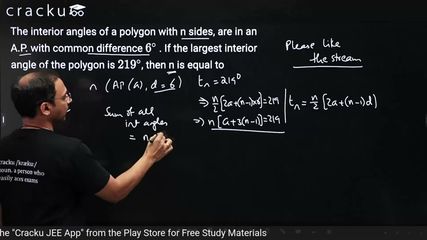
The interior angles of a polygon with n sides, are in an A.P. with common difference $$6^{\circ}$$ . If the largest interior angle of the polygon is $$219^{\circ}$$, then n is equal to
Correct Answer: 20
The interior angles of a polygon with $$n$$ sides are in A.P. with common difference $$6°$$ and the largest angle is $$219°$$.
We start by letting the smallest angle be $$a$$. The angles in A.P. are: $$a, a+6, a+12, \ldots, a+(n-1)\times 6$$.
Since the largest angle is $$219°$$, we have $$a + (n-1)\times 6 = 219$$, which gives $$a = 219 - 6(n-1)\quad\cdots(1)$$.
Next, the sum of interior angles of an $$n$$-sided polygon is $$(n-2)\times 180°$$.
The sum of the A.P. can be written as $$\frac{n}{2}[2a + (n-1)\times 6] = (n-2)\times 180$$.
Noting that the first term is $$a$$ and the last term is $$219$$, this becomes $$\frac{n}{2}[a + 219] = (n-2)\times 180$$.
Substituting $$a$$ from equation (1) into the sum yields $$\frac{n}{2}[219 - 6(n-1) + 219] = (n-2)\times 180$$ $$\frac{n}{2}[438 - 6n + 6]
$$n^2 - 14n - 120 = 0$$.
Solving the quadratic gives $$n = \frac{14 \pm \sqrt{196 + 480}}{2} = \frac{14 \pm \sqrt{676}}{2} = \frac{14 \pm 26}{2}$$, so $$n = \frac{40}{2} = 20$$ or $$n = \frac{-12}{2} = -6$$. We reject $$n = -6$$ since $$n$$ must be positive.
Therefore, n = 20.
Was this solution helpful?
Click on the Email ☝️ to Watch the Video Solution
Create a FREE account and get:
_1.webp)

Educational materials for JEE preparation

Ask our AI anything

AI can make mistakes. Please verify important information.
AI can make mistakes. Please verify important information.
