
Join Our JEE Preparation Group
Prep with like-minded aspirants; Get access to free daily tests and study material.
Sign in
Please select an account to continue using cracku.in
↓ →
Join Our JEE Preparation Group
Prep with like-minded aspirants; Get access to free daily tests and study material.
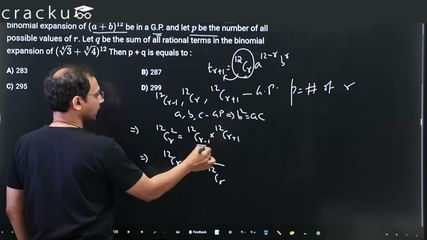
Let the coefficients of three consecutive terms $$T_{r},T_{r+1}$$ and $$T_{r+2}$$ in the binomial expansion of $$(a+b)^{12}$$ be in a G.P. and let $$p$$ be the number of all possible values of $$r$$. Let $$q$$ be the sum of all rational terms in the binomial expansion of $$(\sqrt[4]{3}+\sqrt[3]{4})^{12}$$ Then p + q is equals to :
This problem has two parts. We need to find $$p$$ (number of values of $$r$$) and $$q$$ (sum of rational terms), then compute $$p + q$$.
Part 1: Finding p
In the expansion of $$(a+b)^{12}$$, the general term is $$T_{k+1} = \binom{12}{k} a^{12-k} b^k$$.
The coefficients of $$T_r, T_{r+1}, T_{r+2}$$ are $$\binom{12}{r-1}, \binom{12}{r}, \binom{12}{r+1}$$ respectively.
For these to be in G.P., we need:
$$\binom{12}{r}^2 = \binom{12}{r-1} \cdot \binom{12}{r+1}$$
Using the identity $$\frac{\binom{n}{k}}{\binom{n}{k-1}} = \frac{n-k+1}{k}$$:
$$\frac{\binom{12}{r}}{\binom{12}{r-1}} = \frac{13-r}{r}$$ and $$\frac{\binom{12}{r+1}}{\binom{12}{r}} = \frac{12-r}{r+1}$$
The G.P. condition gives: $$\frac{\binom{12}{r}}{\binom{12}{r-1}} = \frac{\binom{12}{r+1}}{\binom{12}{r}}$$
$$\frac{13-r}{r} = \frac{12-r}{r+1}$$
$$(13-r)(r+1) = r(12-r)$$
$$13r + 13 - r^2 - r = 12r - r^2$$
$$12r + 13 - r^2 = 12r - r^2$$
$$13 = 0$$
This is a contradiction! This means no three consecutive binomial coefficients of $$(a+b)^{12}$$ can form a G.P. Therefore $$p = 0$$.
Part 2: Finding q (sum of rational terms)
In the expansion of $$(3^{1/4} + 4^{1/3})^{12}$$, the general term is:
$$T_{k+1} = \binom{12}{k} (3^{1/4})^{12-k} (4^{1/3})^k = \binom{12}{k} \cdot 3^{(12-k)/4} \cdot 4^{k/3}$$
Since $$4 = 2^2$$, we have $$4^{k/3} = 2^{2k/3}$$.
For the term to be rational, we need both $$\frac{12-k}{4}$$ and $$\frac{k}{3}$$ to be non-negative integers.
From $$\frac{12-k}{4} \in \mathbb{Z}_{\geq 0}$$: $$k \equiv 0 \pmod{4}$$ and $$k \leq 12$$.
From $$\frac{k}{3} \in \mathbb{Z}_{\geq 0}$$: $$k \equiv 0 \pmod{3}$$.
So $$k$$ must be divisible by both 3 and 4, i.e., $$k \equiv 0 \pmod{12}$$.
For $$0 \leq k \leq 12$$: $$k = 0$$ or $$k = 12$$.
For $$k = 0$$: $$T_1 = \binom{12}{0} \cdot 3^{12/4} \cdot 4^0 = 1 \cdot 3^3 \cdot 1 = 27$$
For $$k = 12$$: $$T_{13} = \binom{12}{12} \cdot 3^0 \cdot 4^{12/3} = 1 \cdot 1 \cdot 4^4 = 256$$
Therefore $$q = 27 + 256 = 283$$.
Finally: $$p + q = 0 + 283 = 283$$, which matches Option A.
Was this solution helpful?
Click on the Email ☝️ to Watch the Video Solution
Create a FREE account and get:
_1.webp)

Educational materials for JEE preparation

Ask our AI anything

AI can make mistakes. Please verify important information.
AI can make mistakes. Please verify important information.
