
Join Our JEE Preparation Group
Prep with like-minded aspirants; Get access to free daily tests and study material.
Sign in
Please select an account to continue using cracku.in
↓ →
Join Our JEE Preparation Group
Prep with like-minded aspirants; Get access to free daily tests and study material.
If $$\alpha + i\beta $$ and $$\gamma + i \delta $$ are the roots of $$x^{2}-(3-2i)x-(2i-2)=0,i=\sqrt{-1}$$, then $$\alpha \gamma + \beta \delta $$ is equal to :
The sum of roots $$(\alpha + i\beta) + (\gamma + i\delta) = 3 - 2i$$ and the product of roots $$(\alpha + i\beta)(\gamma + i\delta) = -(2i - 2) = 2 - 2i$$.
Next, expanding the product gives $$(\alpha + i\beta)(\gamma + i\delta) = \alpha\gamma - \beta\delta + i(\alpha\delta + \beta\gamma) = 2 - 2i$$ which leads to the real and imaginary parts $$\alpha\gamma - \beta\delta = 2$$ and $$\alpha\delta + \beta\gamma = -2$$.
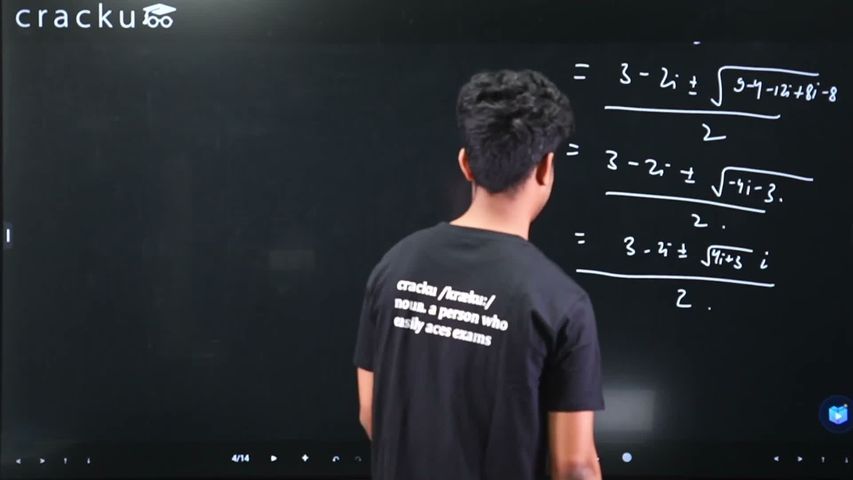
In order to determine $$\alpha\gamma + \beta\delta$$, we apply the quadratic formula: $$x = \frac{(3-2i) \pm \sqrt{(3-2i)^2 + 4(2i-2)}}{2}$$.
We note $$(3-2i)^2 = 9 - 12i + 4i^2 = 5 - 12i$$ and thus the discriminant is $$\Delta = 5 - 12i + 8i - 8 = -3 - 4i$$.
Substituting $$\sqrt{-3-4i} = a + bi$$ yields the system $$a^2 - b^2 = -3$$ and $$2ab = -4$$. From $$2ab = -4$$ we have $$b = -2/a$$, and substituting into $$a^2 - b^2 = -3$$ gives $$a^4 + 3a^2 - 4 = 0$$.
Factoring as $$(a^2 + 4)(a^2 - 1) = 0$$ implies $$a = \pm 1$$. If $$a = 1$$ then $$b = -2$$, so $$\sqrt{-3-4i} = 1 - 2i$$ (up to sign).
Therefore, the roots are $$x = \frac{(3-2i) \pm (1-2i)}{2}$$, giving $$x_1 = \frac{4-4i}{2} = 2 - 2i$$ and $$x_2 = \frac{2}{2} = 1$$.
Hence one root is $$\alpha + i\beta = 2 - 2i$$ and the other is $$\gamma + i\delta = 1 + 0i$$ (or vice versa).
Substituting into $$\alpha\gamma + \beta\delta$$ yields $$2 \cdot 1 + (-2) \cdot 0 = 2$$.
Therefore, the correct answer is Option D) 2.
Was this solution helpful?
Click on the Email ☝️ to Watch the Video Solution
Create a FREE account and get:
_1.webp)

Educational materials for JEE preparation

Ask our AI anything

AI can make mistakes. Please verify important information.
AI can make mistakes. Please verify important information.
