
Join Our JEE Preparation Group
Prep with like-minded aspirants; Get access to free daily tests and study material.
Sign in
Please select an account to continue using cracku.in
↓ →
Join Our JEE Preparation Group
Prep with like-minded aspirants; Get access to free daily tests and study material.
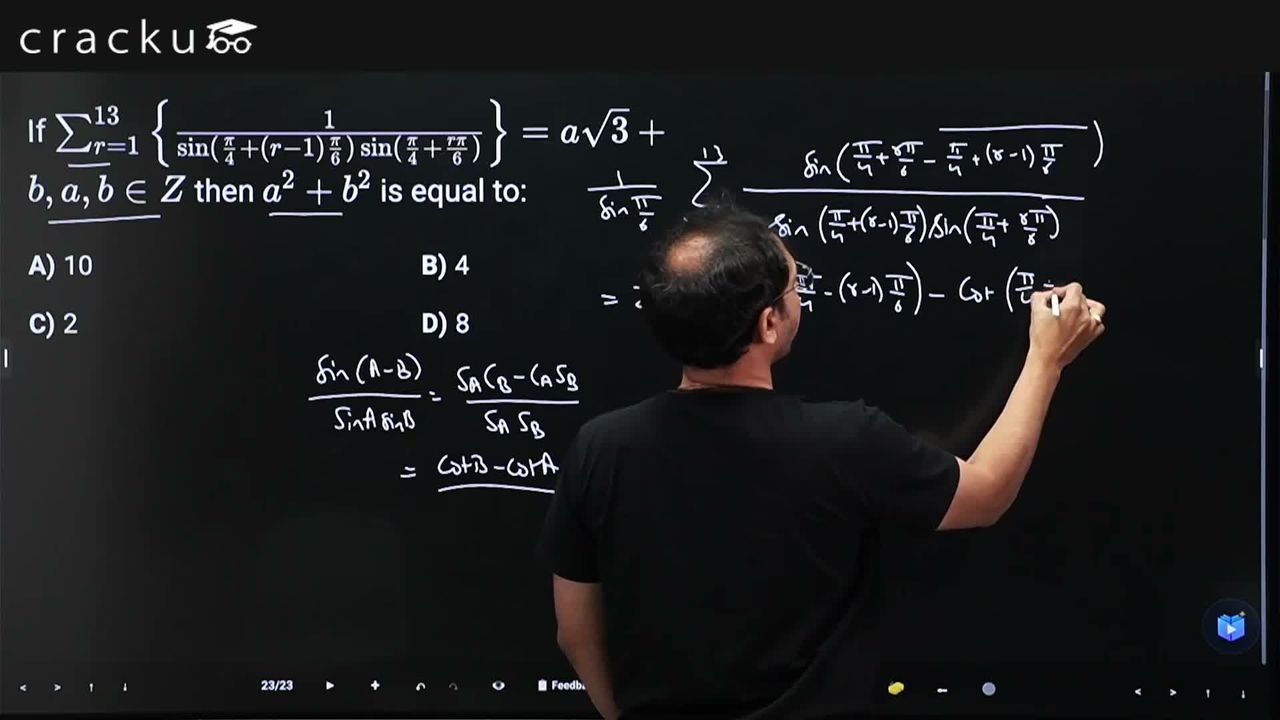
If $$\sum_{r=1}^{13}\left\{\frac{1}{\sin(\frac{\pi}{4}+(r-1)\frac{\pi}{6})\sin(\frac{\pi}{4}+\frac{r\pi}{6})}\right\}=a\sqrt{3}+b,a,b \in Z$$ then $$a^{2}+b^{2}$$ is equal to:
Step 1: Analyze the General Term
Let the general term of the summation be $$T_r$$:
$$T_r = \frac{1}{\sin(\frac{\pi}{4} + (r-1)\frac{\pi}{6}) \sin(\frac{\pi}{4} + \frac{r\pi}{6})}$$
Let the two angles be $$A$$ and $$B$$:
Notice that the difference between these angles is a constant:
$$B - A = \left(\frac{\pi}{4} + \frac{r\pi}{6}\right) - \left(\frac{\pi}{4} + \frac{(r-1)\pi}{6}\right) = \frac{\pi}{6}$$
Step 2: Manipulate the Term to Create a Telescoping Pattern
To split this into a difference of two terms, multiply and divide the numerator by the sine of that constant difference, $$\sin(B-A)$$, which is $$\sin(\frac{\pi}{6})$$.
Since $$\sin(\frac{\pi}{6}) = \frac{1}{2}$$, multiplying by $$\frac{1}{\sin(\pi/6)}$$ is the same as multiplying by $$2$$.
$$T_r = \frac{1}{\sin(\pi/6)} \left[ \frac{\sin(B - A)}{\sin A \sin B} \right]$$
$$T_r = 2 \left[ \frac{\sin B \cos A - \cos B \sin A}{\sin A \sin B} \right]$$
Split the fraction:
$$T_r = 2 \left[ \frac{\sin B \cos A}{\sin A \sin B} - \frac{\cos B \sin A}{\sin A \sin B} \right]$$
$$T_r = 2 [\cot A - \cot B]$$
Substitute the original angle expressions back in for $$A$$ and $$B$$:
$$T_r = 2 \left[ \cot\left(\frac{\pi}{4} + (r-1)\frac{\pi}{6}\right) - \cot\left(\frac{\pi}{4} + \frac{r\pi}{6}\right) \right]$$
Step 3: Expand the Summation
Now, sum this general term from $$r = 1$$ to $$13$$:
$$S = \sum_{r=1}^{13} T_r$$
Write out the first few terms and the last term to see the cancellation:
When you add all these terms together, all the intermediate terms cancel out diagonally. You are left with only the first part of $$T_1$$ and the last part of $$T_{13}$$:
$$S = 2 \left[ \cot\left(\frac{\pi}{4}\right) - \cot\left(\frac{\pi}{4} + \frac{13\pi}{6}\right) \right]$$
Step 4: Evaluate the Remaining Trigonometric Values
We know that $$\cot(\frac{\pi}{4}) = 1$$.
Now, simplify the angle in the second term:
$$\frac{\pi}{4} + \frac{13\pi}{6} = \frac{\pi}{4} + 2\pi + \frac{\pi}{6}$$
Since the cotangent function has a period of $$\pi$$ (and therefore repeats every $$2\pi$$), we can drop the $$2\pi$$:
$$\cot\left(2\pi + \frac{\pi}{4} + \frac{\pi}{6}\right) = \cot\left(\frac{\pi}{4} + \frac{\pi}{6}\right) = \cot(45^\circ + 30^\circ) = \cot(75^\circ)$$
Let's find $$\cot(75^\circ)$$ by first finding $$\tan(75^\circ)$$:
$$\tan(75^\circ) = \tan(45^\circ + 30^\circ) = \frac{\tan 45^\circ + \tan 30^\circ}{1 - \tan 45^\circ \tan 30^\circ}$$
$$\tan(75^\circ) = \frac{1 + \frac{1}{\sqrt{3}}}{1 - \frac{1}{\sqrt{3}}} = \frac{\sqrt{3} + 1}{\sqrt{3} - 1}$$
Rationalize the denominator by multiplying by the conjugate:
$$\tan(75^\circ) = \frac{(\sqrt{3} + 1)^2}{(\sqrt{3} - 1)(\sqrt{3} + 1)} = \frac{3 + 1 + 2\sqrt{3}}{3 - 1} = \frac{4 + 2\sqrt{3}}{2} = 2 + \sqrt{3}$$
Since $\cot(75^\circ)$ is the reciprocal:
$$\cot(75^\circ) = \frac{1}{2 + \sqrt{3}}$$
Rationalize this by multiplying numerator and denominator by $$(2 - \sqrt{3})$$:
$$\cot(75^\circ) = \frac{2 - \sqrt{3}}{4 - 3} = 2 - \sqrt{3}$$
Step 5: Final Calculation
Substitute these evaluated numbers back into the simplified sum equation:
$$S = 2 [ 1 - (2 - \sqrt{3}) ]$$
$$S = 2 [ -1 + \sqrt{3} ]$$
$$S = 2\sqrt{3} - 2$$
The problem states that $$S = a\sqrt{3} + b$$. By comparing coefficients, we get:
$$a = 2$$
$$b = -2$$
(Both $$2$$ and $$-2$$ belong to $$\mathbb{Z}$$, satisfying the condition).
Finally, calculate $$a^2 + b^2$$:
$$a^2 + b^2 = (2)^2 + (-2)^2 = 4 + 4 = 8$$
The correct answer is 8.
Was this solution helpful?
Click on the Email ☝️ to Watch the Video Solution
Create a FREE account and get:
_1.webp)

Educational materials for JEE preparation

Ask our AI anything

AI can make mistakes. Please verify important information.
AI can make mistakes. Please verify important information.
