
Join Our JEE Preparation Group
Prep with like-minded aspirants; Get access to free daily tests and study material.
Sign in
Please select an account to continue using cracku.in
↓ →
Join Our JEE Preparation Group
Prep with like-minded aspirants; Get access to free daily tests and study material.
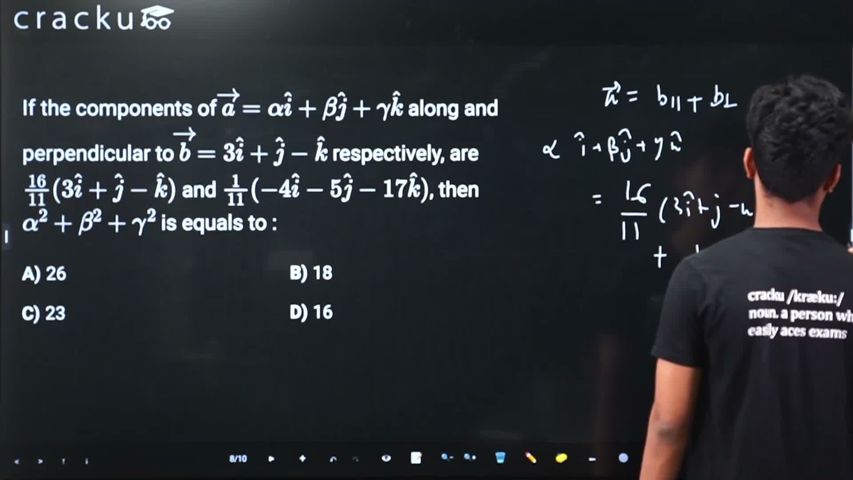
If the components of $$\overrightarrow{a} = \alpha \hat{i}+\beta \hat{j}+\gamma \hat{k}$$ along and perpendicular to $$\overrightarrow{b}= 3\hat{i}+\hat{j}-\hat{k}$$ respectively, are $$\frac{16}{11}(3\hat{i}+\hat{j}-\hat{k})$$ and $$\frac{1}{11}(-4\hat{i}-5\hat{j}-17\hat{k})$$, then $$\alpha^{2} + \beta^{2} + \gamma^{2}$$ is equals to :
Here is the mathematically formatted version of your solution using standard LaTeX:
Given that the vector $\mathbf{a}$ can be resolved into a component along vector $$\mathbf{b}$$ and a component perpendicular to vector $$\mathbf{b}$$:
$$\mathbf{a} = \mathbf{a}_{\parallel} + \mathbf{a}_{\perp}$$
$$\mathbf{a}$$ = $$\frac{16}{11}(3\hat{i} + \hat{j} - \hat{k})$$ + $$\frac{1}{11}(-4\hat{i} - 5\hat{j} - 17\hat{k})$$
Taking $$\frac{1}{11}$$ as a common factor:
$$\mathbf{a} = \frac{1}{11} \left[ (48\hat{i} + 16\hat{j} - 16\hat{k}) + (-4\hat{i} - 5\hat{j} - 17\hat{k}) \right]$$
$$\mathbf{a} = \frac{1}{11} (44\hat{i} + 11\hat{j} - 33\hat{k})$$ $$\mathbf{a} = 4\hat{i} + \hat{j} - 3\hat{k}$$
Let $$\mathbf{a} = \alpha\hat{i} + \beta\hat{j} + \gamma\hat{k}$$. By comparing coefficients, we get:
Now, calculate $$\alpha^2 + \beta^2 + \gamma^2$$:
$$\alpha^2 + \beta^2 + \gamma^2 = (4)^2 + (1)^2 + (-3)^2$$ $$\alpha^2 + \beta^2 + \gamma^2 = 16 + 1 + 9 = 26$$
Was this solution helpful?
Click on the Email ☝️ to Watch the Video Solution
Create a FREE account and get:
_1.webp)

Educational materials for JEE preparation

Ask our AI anything

AI can make mistakes. Please verify important information.
AI can make mistakes. Please verify important information.
