Join Our JEE Preparation Group
Prep with like-minded aspirants; Get access to free daily tests and study material.
Sign in
Please select an account to continue using cracku.in
↓ →
Join Our JEE Preparation Group
Prep with like-minded aspirants; Get access to free daily tests and study material.
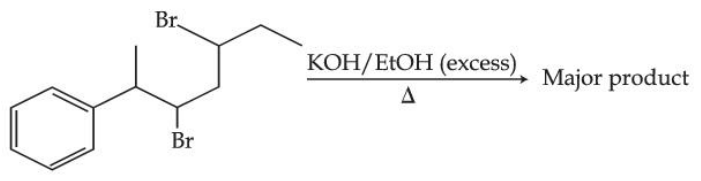
The substrate supplied in the problem (two vicinal bromo-substituents in an aliphatic chain bearing a phenyl group) is treated with hot alcoholic $$\text{KOH}$$. Alcoholic $$\text{KOH}$$ is a strong base and therefore promotes bimolecular dehydro-halogenation (E2). Because two bromine atoms are present, two consecutive E2 eliminations can occur.
Step 1 : First E2 elimination
The base abstracts a β-hydrogen that is anti-periplanar to one of the C-Br bonds. The departure of Br⁻ in the same transition state furnishes an alkene. Among the several hydrogens that can be removed, the one that gives the more substituted alkene and simultaneously places the double bond conjugated with the benzene ring is preferred (Saytzeff rule + conjugative stabilisation). Hence the first elimination produces the intermediate
$$\mathrm{Ph\!-\!CH=CH\!-\!CH_2\!-\!CH(Br)\!-\!CH_2\!-\!CH_3}$$
This alkene is allylic to the phenyl ring and therefore stabilised.
Step 2 : Second E2 elimination
The remaining bromo group is still β to at least one hydrogen. A second molecule of base removes the β-H that is anti-periplanar to the C-Br bond. The double bond generated in this step can appear in two possible positions, but the product in which the two C=C bonds are conjugated with each other as well as with the phenyl ring is vastly more stable. Therefore the elimination gives
$$\mathrm{Ph\!-\!CH=CH\!-\!CH=CH\!-\!CH_2\!-\!CH_3}$$
This molecule is named as 2-phenylhepta-2,4-diene.
Why the other isomeric dienes are not formed in major amounts
A. 2-Phenylhepta-2,5-diene and C. 6-Phenylhepta-3,5-diene are non-conjugated; they lack the extended π-system and are therefore less stable.
B. 6-Phenylhepta-2,4-diene keeps the conjugation between the two C=C bonds but places the phenyl ring out of the conjugated segment; again it is less stabilised than the product obtained above.
D. 2-Phenylhepta-2,4-diene enjoys full conjugation over the phenyl ring and both double bonds, so it is the thermodynamically favoured (major) product.
Hence the major product is
Option D which is : 2-Phenylhepta-2,4-diene
Was this solution helpful?
Create a FREE account and get:
_1.webp)

Educational materials for JEE preparation

Ask our AI anything

AI can make mistakes. Please verify important information.
AI can make mistakes. Please verify important information.