
Join Our JEE Preparation Group
Prep with like-minded aspirants; Get access to free daily tests and study material.
Sign in
Please select an account to continue using cracku.in
↓ →
Join Our JEE Preparation Group
Prep with like-minded aspirants; Get access to free daily tests and study material.
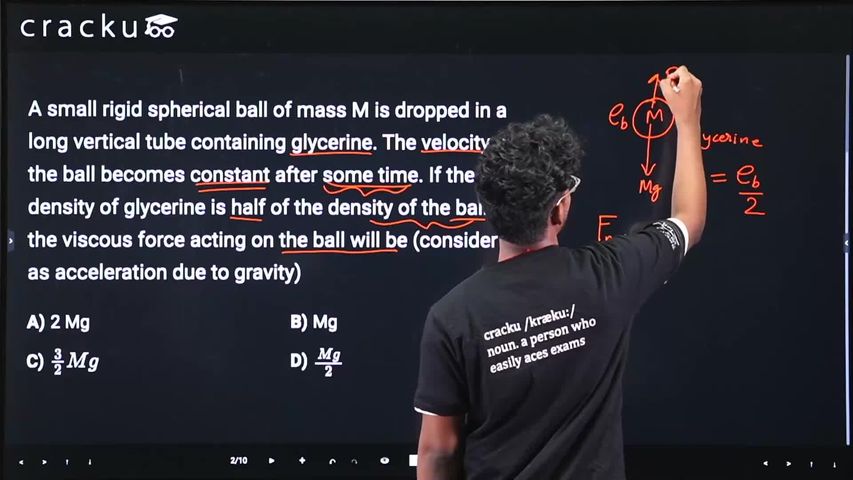
A small rigid spherical ball of mass M is dropped in a long vertical tube containing glycerine. The velocity of the ball becomes constant after some time. If the density of glycerine is half of the density of the ball, then the viscous force acting on the ball will be (consider g as acceleration due to gravity)
When the ball reaches terminal velocity, the net force acting on it is zero. The forces involved are:
1. Weight of the ball acting downward: $$W = Mg$$
2. Buoyant force acting upward: This equals the weight of the glycerine displaced by the ball. Let the volume of the ball be $$V$$. The buoyant force is given by $$F_b = \rho_g V g$$, where $$\rho_g$$ is the density of glycerine.
3. Viscous force acting upward: Denoted as $$F_v$$.
Given that the density of glycerine is half the density of the ball, let the density of the ball be $$\rho_b$$. Then:
$$\rho_g = \frac{1}{2} \rho_b$$
The mass of the ball is related to its density and volume by:
$$M = \rho_b V$$
Solving for volume:
$$V = \frac{M}{\rho_b}$$
Substitute this into the buoyant force formula:
$$F_b = \rho_g V g = \left(\frac{1}{2} \rho_b\right) \times \left(\frac{M}{\rho_b}\right) g = \frac{1}{2} M g$$
At terminal velocity, the net force is zero, so upward forces equal downward forces:
$$F_b + F_v = W$$
Substitute the expressions:
$$\frac{1}{2} M g + F_v = M g$$
Solve for the viscous force $$F_v$$:
$$F_v = M g - \frac{1}{2} M g = \frac{1}{2} M g$$
Therefore, the viscous force acting on the ball is $$\frac{Mg}{2}$$.
The correct option is D. $$\frac{Mg}{2}$$
Was this solution helpful?
Click on the Email ☝️ to Watch the Video Solution
Create a FREE account and get:
_1.webp)

Educational materials for JEE preparation

Ask our AI anything

AI can make mistakes. Please verify important information.
AI can make mistakes. Please verify important information.
