
Join Our JEE Preparation Group
Prep with like-minded aspirants; Get access to free daily tests and study material.
Sign in
Please select an account to continue using cracku.in
↓ →
Join Our JEE Preparation Group
Prep with like-minded aspirants; Get access to free daily tests and study material.
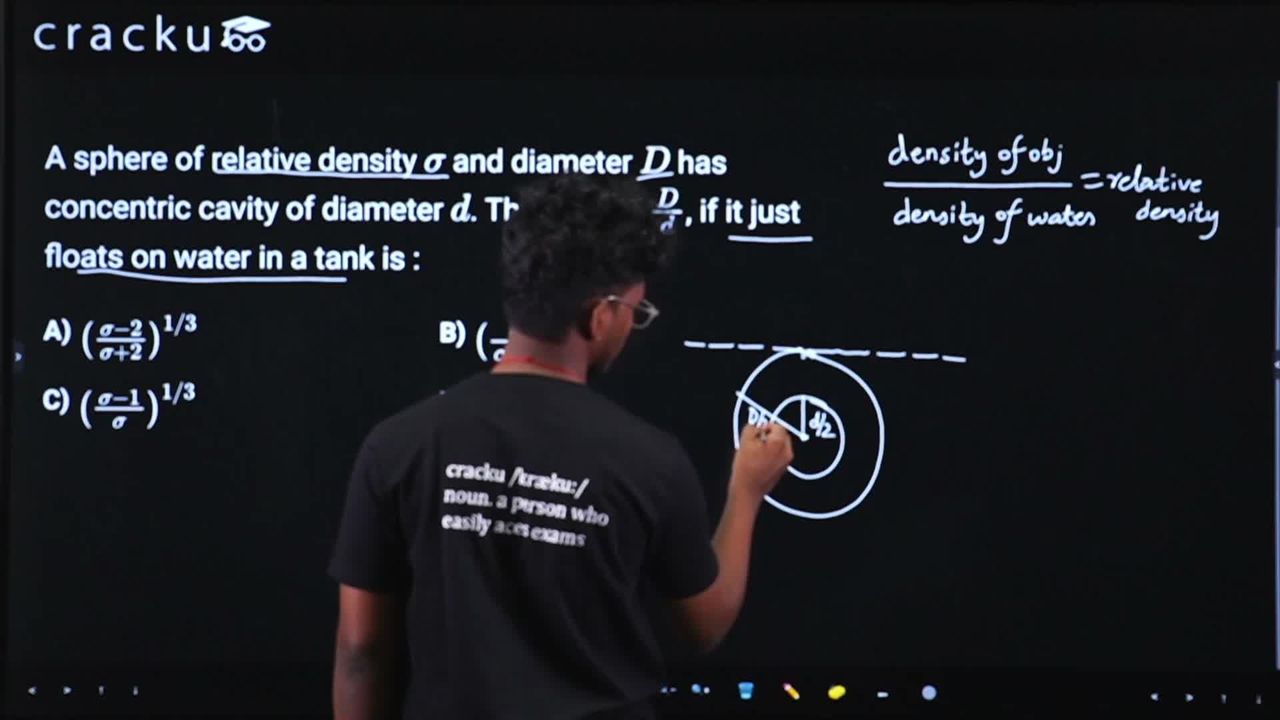
A sphere of relative density $$\sigma$$ and diameter $$D$$ has concentric cavity of diameter $$d$$. The ratio of $$\frac{D}{d}$$, if it just floats on water in a tank is :
A sphere of relative density $$\sigma$$, outer diameter $$D$$, with a concentric cavity of diameter $$d$$, just floats on water.
"Just floats" means the sphere is fully submerged with no net force (weight = buoyant force).
Mass of the sphere = $$\sigma \rho_w \times \frac{\pi}{6}(D^3 - d^3)$$ (volume of material times density of material, where density = $$\sigma \rho_w$$).
Weight = $$\sigma \rho_w g \cdot \frac{\pi}{6}(D^3 - d^3)$$.
Buoyant force = $$\rho_w g \cdot \frac{\pi}{6}D^3$$ (displaced water volume = total sphere volume).
Setting equal:
$$\sigma(D^3 - d^3) = D^3$$
$$\sigma D^3 - \sigma d^3 = D^3$$
$$D^3(\sigma - 1) = \sigma d^3$$
$$\frac{D^3}{d^3} = \frac{\sigma}{\sigma - 1}$$
$$\frac{D}{d} = \left(\frac{\sigma}{\sigma - 1}\right)^{1/3}$$
The correct answer is Option 2: $$\left(\frac{\sigma}{\sigma - 1}\right)^{1/3}$$.
Was this solution helpful?
Click on the Email ☝️ to Watch the Video Solution
Create a FREE account and get:
_1.webp)

Educational materials for JEE preparation

Ask our AI anything

AI can make mistakes. Please verify important information.
AI can make mistakes. Please verify important information.
