
Join Our JEE Preparation Group
Prep with like-minded aspirants; Get access to free daily tests and study material.
Sign in
Please select an account to continue using cracku.in
↓ →
Join Our JEE Preparation Group
Prep with like-minded aspirants; Get access to free daily tests and study material.
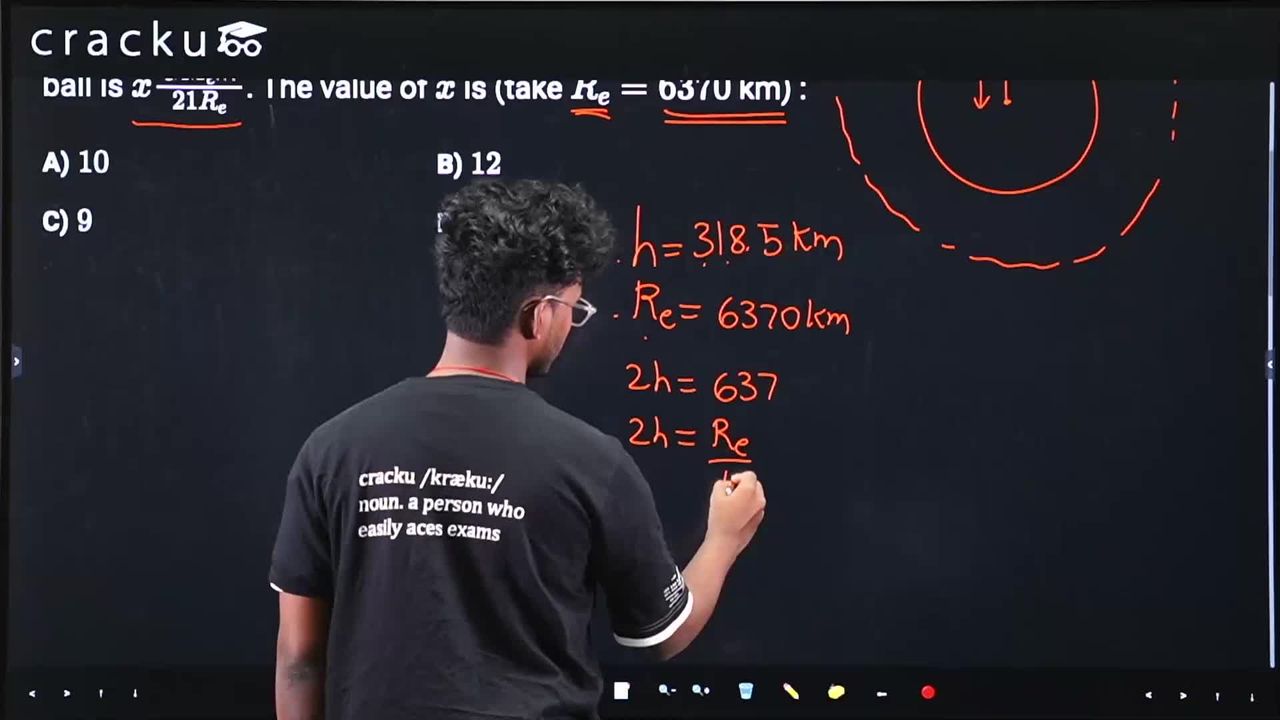
An astronaut takes a ball of mass $$m$$ from earth to space. He throws the ball into a circular orbit about earth at an altitude of $$318.5$$ km. From earth's surface to the orbit, the change in total mechanical energy of the ball is $$x\frac{GM_e m}{21R_e}$$. The value of $$x$$ is (take $$R_e = 6370$$ km) :
The total mechanical energy on Earth's surface: $$E_1 = -\frac{GM_em}{R_e}$$ (taking KE = 0 on surface).
on Earth's surface, the ball is at rest, so $$KE = 0$$ and $$PE = -\frac{GM_em}{R_e}$$. Total $$E_1 = -\frac{GM_em}{R_e}$$.
In circular orbit at altitude $$h = 318.5$$ km:
$$r = R_e + h = 6370 + 318.5 = 6688.5 \text{ km}$$
$$\frac{r}{R_e} = \frac{6688.5}{6370} = \frac{6688.5}{6370}$$. Let me simplify: $$\frac{6688.5}{6370} = 1 + \frac{318.5}{6370} = 1 + \frac{1}{20} = \frac{21}{20}$$.
So $$r = \frac{21}{20}R_e$$.
Total energy in orbit: $$E_2 = -\frac{GM_em}{2r} = -\frac{GM_em}{2 \cdot \frac{21}{20}R_e} = -\frac{10GM_em}{21R_e}$$.
Change in total energy:
$$\Delta E = E_2 - E_1 = -\frac{10GM_em}{21R_e} + \frac{GM_em}{R_e} = GM_em\left(\frac{1}{R_e} - \frac{10}{21R_e}\right) = \frac{GM_em}{R_e}\left(\frac{21-10}{21}\right) = \frac{11GM_em}{21R_e}$$
Comparing with $$x\frac{GM_em}{21R_e}$$: $$x = 11$$.
The correct answer is Option 4: 11.
Was this solution helpful?
Click on the Email ☝️ to Watch the Video Solution
Create a FREE account and get:
_1.webp)

Educational materials for JEE preparation

Ask our AI anything

AI can make mistakes. Please verify important information.
AI can make mistakes. Please verify important information.
